



Question: Use the Divergence Theorem to calculate the surface integral S F ds; that is, calculate the flux of F across S. F(x, y,
Use the Divergence Theorem to calculate the surface integral ∫∫S F · ds; that is, calculate the flux of F across S.
F(x, y, z) = x3yi – x2y2 j – x2yz k, S is the surface of the solid bounded by the hyperboloid x2 + y2 – z2 = 1 and the planes z = –2 and z = 2
Data from the Divergence Theorem
Let E be a simple solid region and let S be the boundary surface of E, given with positive (outward) orientation. Let F be a vector field whose component functions have continuous partial derivatives on an open region that contains E. Then
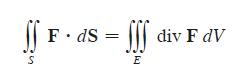
S F. dS SSS E div F dV
Step by Step Solution
3.30 Rating (159 Votes )
There are 3 Steps involved in it
To apply the Divergence Theorem to calculate the surface integral F... View full answer

Get step-by-step solutions from verified subject matter experts