



Question: Suppose q > 0 units of a commodity are produced at a total cost of C(q) dollars and an average cost of In this section,
Suppose q > 0 units of a commodity are produced at a total cost of C(q) dollars and an average cost of
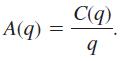
In this section, we showed that q = qc satisfies A'(qc) = 0 if and only if C'(qc) = A(qc); that is, when marginal cost equals average cost. The purpose of this problem is to show that A(q) is minimized when q = qc.
a. Generally speaking, the cost of producing a commodity increases at an increasing rate as more and more goods are produced. Using this economic principle, what can be said about the sign of C"(q) as q increases?
b. Show that A"(qc) > 0 if and only if C"(qc) > 0. Then use part (a) to argue that average cost A(q) is minimized when q = qc.
A(q) C(q) 9
Step by Step Solution
3.43 Rating (162 Votes )
There are 3 Steps involved in it
a For Cq to be increasing at an increasing rate we must have Cq 0 as ... View full answer

Get step-by-step solutions from verified subject matter experts