







Question: The following table contains the average distance D from the sun for the eight planets and their period P of revolution around the sun in
The following table contains the average distance D from the sun for the eight planets and their period P of revolution around the sun in years.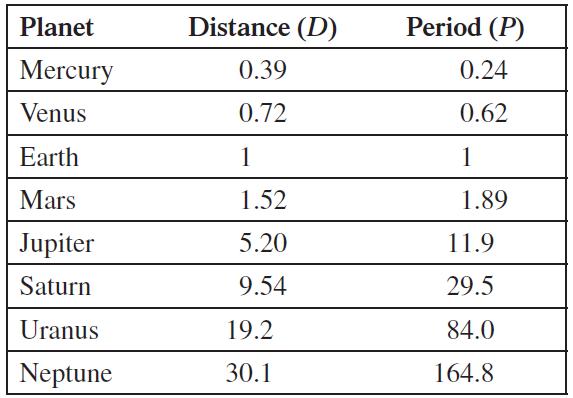
The distances are given in astronomical units (A.U.); 1 A.U. is the average distance from Earth to the sun. For example, since Jupiter’s distance is 5.2 A.U., its distance from the sun is 5.2 times farther than Earth’s.
(a) Find functions of the form P = kDn for n = 1, 1.5, and 2 that fit the data at Neptune.
(b) Use a graphing calculator to plot the data in the table and to graph the three functions found in part (a). Which function best fits the data?
(c) Use the best-fitting function from part (b) to predict the period of Pluto (which was removed from the list of planets in 2006), which has a distance from the sun of 39.5 A.U. Compare your answer to the true value of 248.5 years.
(d) If you have a graphing calculator or computer program with a power regression feature, use it to find a power function (a function of the form P = kDn) that approximately fits the data. How does this answer compare with the answer to part (b)
Planet Mercury Venus Earth Mars Jupiter Saturn Uranus Neptune Distance (D) 0.39 0.72 1 1.52 5.20 9.54 19.2 30.1 Period (P) 0.24 0.62 1 1.89 11.9 29.5 84.0 164.8
Step by Step Solution
3.42 Rating (161 Votes )
There are 3 Steps involved in it
a b P 100D 15 appears to be the best fit c P 100395 15 2483 ... View full answer

Get step-by-step solutions from verified subject matter experts
 Study Help