







Question: In a study designed to evaluate whether an educational program makes sexually active adolescents more likely to obtain condoms, adolescents were randomly assigned to two
In a study designed to evaluate whether an educational program makes sexually active adolescents more likely to obtain condoms, adolescents were randomly assigned to two experimental groups. The educational program, involving a lecture and videotape about transmission of the HIV virus, was provided to one group but not the other. In logistic regression models, factors observed to influence a teenager to obtain condoms were gender, socioeconomic status,
lifetime number of partners, and the experimental group. Study results are summarized in Table 5.14.
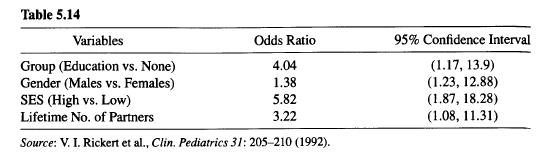
a. Interpret the odds ratio and the related confidence interval for the effect of group.
b. Find the parameter estimates for the fitted model, using (1,0) dummy vari- ables for the first three predictors. Based on the corresponding confidence interval for the log odds ratio, determine the standard error for the group effect.
c. Explain why either the estimate of 1.38 for the odds ratio for gender or the corresponding confidence interval is incorrect. Show that if the reported interval is correct, then 1.38 is actually the log odds ratio, and the estimated odds ratio equals 3.98.
Table 5.14 Variables Group (Education vs. None) Gender (Males vs. Females) SES (High vs. Low) Lifetime No. of Partners (1.17, 13.9) Odds Ratio 95% Confidence Interval 4.04 1.38 5.82 3.22 Source: V. I. Rickert et al., Clin. Pediatrics 31: 205-210 (1992). (1.23, 12.88) (1.87, 18.28) (1.08, 11.31)
Step by Step Solution
There are 3 Steps involved in it

Get step-by-step solutions from verified subject matter experts
 Study Help