







Question: Assume that the ISP in the previous problem decided to use token buckets (of capacity c = 20 and rate r = 10) instead of
Assume that the ISP in the previous problem decided to use token buckets (of capacity c = 20 and rate r = 10) instead of leaky buckets to give credit to the customer that does not send cells for a while but needs to send some bursts later. Each token bucket is implemented by a very large queue for each customer (no packet drop), a bucket that holds the token, and the timer that regulates dropping tokens in the bucket. (See Figure 30.17.)
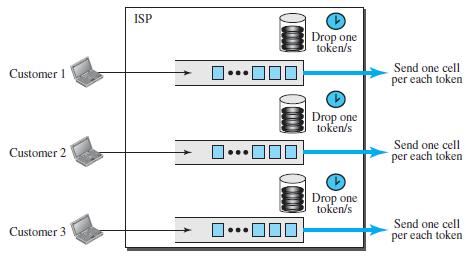
a. Show the customer rate, the contents of the queue, and the contents of the bucket for the first customer, which sends 5 cells per second for the first 7 seconds and 15 cells per second for the next 9 seconds.
b. Do the same for the second customer, which sends 15 cells per second for the first 4 seconds and 5 cells per second for the next 14 seconds.
c. Do the same for the third customer, which sends no cells for the first 2 seconds, 20 cells for the next 2 seconds, and repeats the pattern 4 times.
ISP Drop one token/s Send one cell per each token Customer 1 Drop one token/s Send one cell per each token Customer 2 Drop one token/s Send one cell per each token Customer 3
Step by Step Solution
3.52 Rating (165 Votes )
There are 3 Steps involved in it
To better understand the behavior of the token bucket in this problem we first create a table in each case to show the movement of cells and tokens in the system The flow diagram can follow the table ... View full answer

Get step-by-step solutions from verified subject matter experts
 Study Help