







Question: The 1982 Ethernet specification allowed between any two stations up to 1500 m of coaxial cable, 1000 m of other point-to-point link cable, and two
The 1982 Ethernet specification allowed between any two stations up to 1500 m of coaxial cable, 1000 m of other point-to-point link cable, and two repeaters. Each station or repeater connects to the coaxial cable via up to 50 m of “drop cable.” Typical delays associated with each device are given in Table 2.
5 (where c = speed of light in a vacuum = 3 × 10⁸ m/s). What is the worst-case round-trip propagation delay, measured in bits, due to the sources listed? (This list is not complete; other sources of delay include sense time and signal rise time.)
Table 2.5
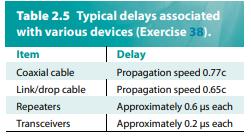
Table 2.5 Typical delays associated with various devices (Exercise 38). Item Coaxial cable Link/drop cable Repeaters Transceivers Delay Propagation speed 0.77c Propagation speed 0.65c Approximately 0.6 s each Approximately 0.2 us each
Step by Step Solution
3.34 Rating (166 Votes )
There are 3 Steps involved in it
To calculate the worstcase roundtrip propagation delay in bits due to the sources listed in Table 25 lets first calculate the time taken for a signal ... View full answer

Get step-by-step solutions from verified subject matter experts
 Study Help