







Question: Modify the declaration of the first for loop in the Test class in Code Fragment 1.4 so that its charges will eventually cause exactly one
Modify the declaration of the first for loop in the Test class in Code Fragment 1.4 so that its charges will eventually cause exactly one of the three credit cards to go over its credit limit. Which credit card is it?
Data from in Fragment 1.4
Let us start with the second line. The #define statement defines a preprocessor variable CREDIT CARD H. This variable’s name is typically based on the header file name, and by convention, it is written in all capitals. The name itself is not important as long as different header files use different names. The entire file is enclosed in a preprocessor “if” block starting with #ifndef on top and ending with #endif at the bottom. The “ifndef” is read “if not defined,” meaning that the header file contents will be expanded only if the preprocessor variable CREDIT CARD H is not defined. Here is how it works. The first time the header file is encountered, the variable
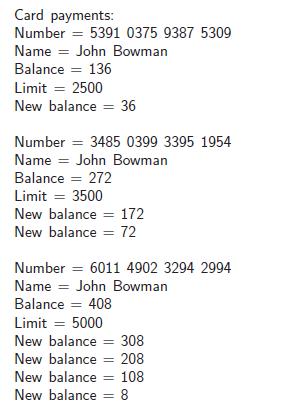
Card payments: Number = 5391 0375 9387 5309 Name = John Bowman Balance = 136 Limit = 2500 New balance 36 Number = 3485 0399 3395 1954 Name = John Bowman Balance = 272 Limit = 3500 New balance = 172 New balance = 72 Number 6011 4902 3294 2994 Name = John Bowman Balance 408 = Limit = 5000 New balance = 308 New balance = 208 New balance = 108 New balance 8 =
Step by Step Solution
3.45 Rating (148 Votes )
There are 3 Steps involved in it
Answer class CreditCard A consumer credit card def initself customer bank acnt limit Create a new credit card instance The initial balance is zero cus... View full answer

Get step-by-step solutions from verified subject matter experts
 Study Help