







Question: Exercise 1.4 introduces a study on using the Buteyko shallow breathing technique to reduce asthma symptoms and improve quality of life. As part of this
Exercise 1.4 introduces a study on using the Buteyko shallow breathing technique to reduce asthma symptoms and improve quality of life. As part of this study 600 asthma patients aged 18-69 who relied on medication for asthma treatment were recruited and randomly assigned to two groups: one practiced the Buteyko method and the other did not. Those in the Buteyko group experienced, on average, a significant reduction in asthma symptoms and an improvement in quality of life.
(a) Identify the population of interest and the sample in this study.
(b) Comment on whether or not the results of the study can be generalized to the population, and if the findings of the study can be used to establish causal relationships.
Data From Exercise 1.4
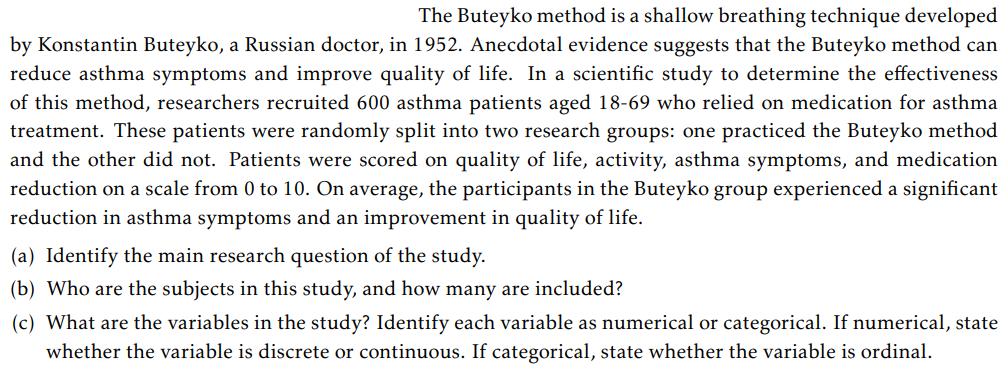
The Buteyko method is a shallow breathing technique developed by Konstantin Buteyko, a Russian doctor, in 1952. Anecdotal evidence suggests that the Buteyko method can reduce asthma symptoms and improve quality of life. In a scientific study to determine the effectiveness of this method, researchers recruited 600 asthma patients aged 18-69 who relied on medication for asthma treatment. These patients were randomly split into two research groups: one practiced the Buteyko method and the other did not. Patients were scored on quality of life, activity, asthma symptoms, and medication reduction on a scale from 0 to 10. On average, the participants in the Buteyko group experienced a significant reduction in asthma symptoms and an improvement in quality of life. (a) Identify the main research question of the study. (b) Who are the subjects in this study, and how many are included? (c) What are the variables in the study? Identify each variable as numerical or categorical. If numerical, state whether the variable is discrete or continuous. If categorical, state whether the variable is ordinal.
Step by Step Solution
3.35 Rating (164 Votes )
There are 3 Steps involved in it

Get step-by-step solutions from verified subject matter experts
 Study Help