







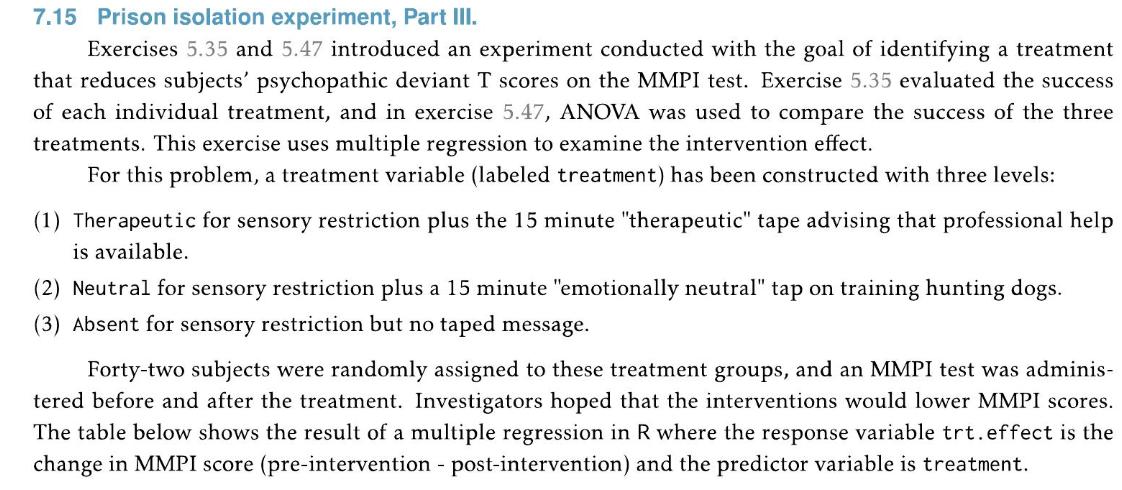
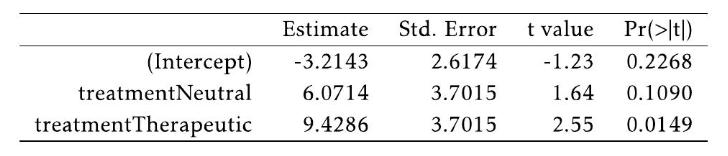
Question: Problem 7.15 used a regression model to examine the effect of the interventions on possibly reducing psychopathic deviant (mathrm{T}) scores on prisoners. The regression model
Problem 7.15 used a regression model to examine the effect of the interventions on possibly reducing psychopathic deviant \(\mathrm{T}\) scores on prisoners. The regression model is shown in the problem statement.
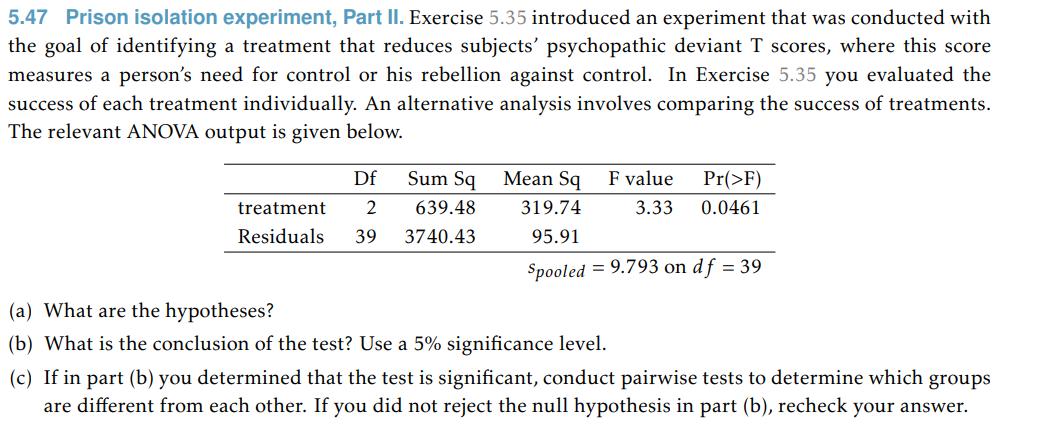
(a) The value of the \(F\)-statistic is 3.33 with 2 and 39 degrees of freedom and \(P\left(F_{2,39}>3.33\right)=0.0461\). In terms of the variables in the regression model, state the null hypothesis that corresponds to the \(F\)-statistic.
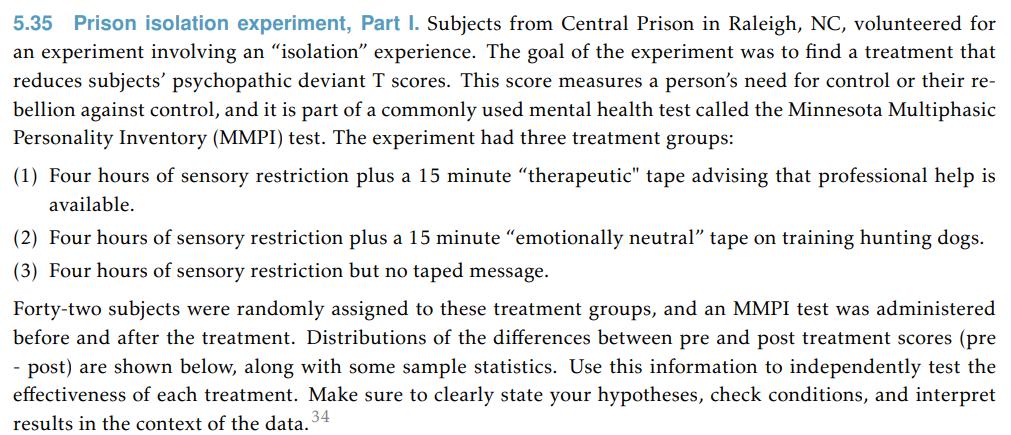
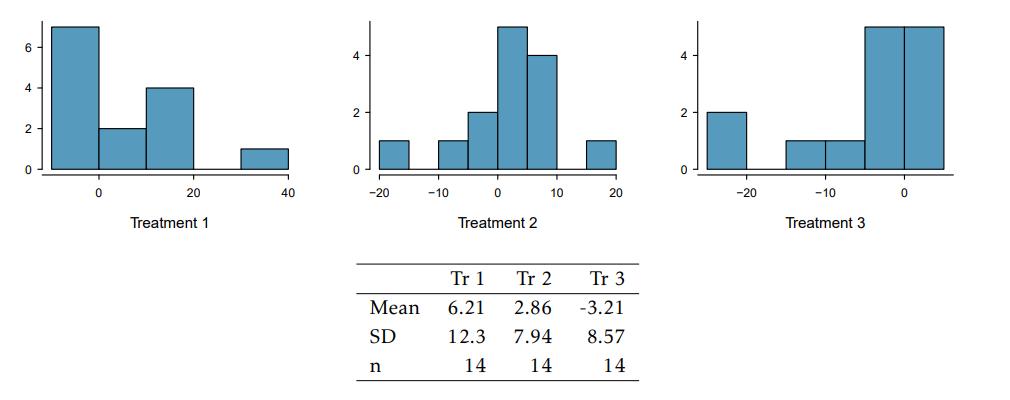
(b) Describe the relationship between the coefficients from the linear model and the usual summary statistics for the three sets of difference scores.
(c) Explain why the null hypothesis in this regression model is equivalent to the null hypothesis when these data were analyzed using ANOVA in Problem 5.47.
(d) Explain whether the assumptions for this regression model differ from those used in ANOVA.
Data From Problem 7.15
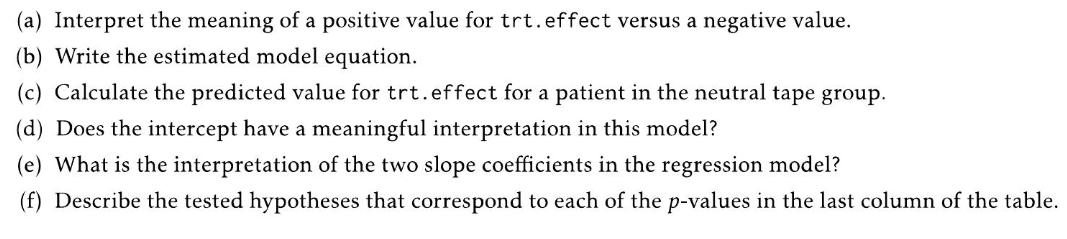
Data From 5.35
Data From 5.47
7.15 Prison isolation experiment, Part III. Exercises 5.35 and 5.47 introduced an experiment conducted with the goal of identifying a treatment that reduces subjects' psychopathic deviant T scores on the MMPI test. Exercise 5.35 evaluated the success of each individual treatment, and in exercise 5.47, ANOVA was used to compare the success of the three treatments. This exercise uses multiple regression to examine the intervention effect. For this problem, a treatment variable (labeled treatment) has been constructed with three levels: (1) Therapeutic for sensory restriction plus the 15 minute "therapeutic" tape advising that professional help is available. (2) Neutral for sensory restriction plus a 15 minute "emotionally neutral" tap on training hunting dogs. (3) Absent for sensory restriction but no taped message. Forty-two subjects were randomly assigned to these treatment groups, and an MMPI test was adminis- tered before and after the treatment. Investigators hoped that the interventions would lower MMPI scores. The table below shows the result of a multiple regression in R where the response variable trt. effect is the change in MMPI score (pre-intervention - post-intervention) and the predictor variable is treatment.
Step by Step Solution
3.50 Rating (150 Votes )
There are 3 Steps involved in it

Get step-by-step solutions from verified subject matter experts
 Study Help