



Question: The hospital administrator mentioned in Exercise 4.7 randomly selected 64 patients and measured the time (in minutes) between when they checked in to the ER
The hospital administrator mentioned in Exercise 4.7 randomly selected 64 patients and measured the time (in minutes) between when they checked in to the ER and the time they were first seen by a doctor. The average time is 137.5 minutes and the standard deviation is 39 minutes. She is getting grief from her supervisor on the basis that the wait times in the ER has increased greatly from last year's average of 127 minutes. However, she claims that the increase is probably just due to chance.
(a) Calculate a \(95 \%\) confidence interval. Is the change in wait times statistically significant at the \(\alpha=0.05\) level?
(b) Would the conclusion in part
(a) change if the significance level were changed to \(\alpha=0.01\) ?
(c) Is the supervisor justified in criticizing the hospital administrator regarding the change in ER wait times? How might you present an argument in favor of the administrator?
Data From Exercise 4.7
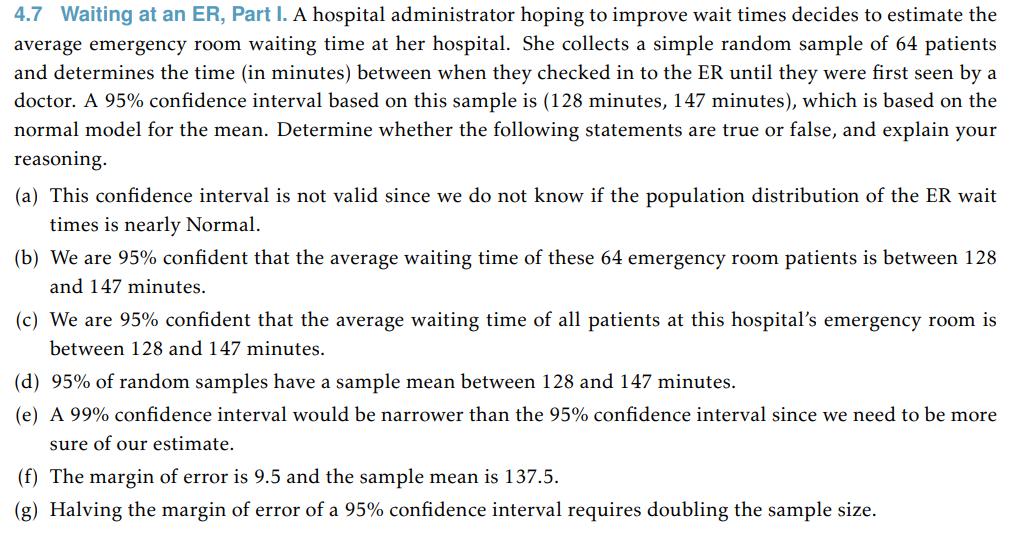
4.7 Waiting at an ER, Part I. A hospital administrator hoping to improve wait times decides to estimate the average emergency room waiting time at her hospital. She collects a simple random sample of 64 patients and determines the time (in minutes) between when they checked in to the ER until they were first seen by a doctor. A 95% confidence interval based on this sample is (128 minutes, 147 minutes), which is based on the normal model for the mean. Determine whether the following statements are true or false, and explain your reasoning. (a) This confidence interval is not valid since we do not know if the population distribution of the ER wait times is nearly Normal. (b) We are 95% confident that the average waiting time of these 64 emergency room patients is between 128 and 147 minutes. (c) We are 95% confident that the average waiting time of all patients at this hospital's emergency room is between 128 and 147 minutes. (d) 95% of random samples have a sample mean between 128 and 147 minutes. (e) A 99% confidence interval would be narrower than the 95% confidence interval since we need to be more sure of our estimate. (f) The margin of error is 9.5 and the sample mean is 137.5. (g) Halving the margin of error of a 95% confidence interval requires doubling the sample size.
Step by Step Solution
3.53 Rating (146 Votes )
There are 3 Steps involved in it

Get step-by-step solutions from verified subject matter experts