



Question: The quantization error of an ADC such as the one in Figure 11-13 is always positive because the V AX value must exceed V A
The quantization error of an ADC such as the one in Figure 11-13 is always positive because the VAX value must exceed VA in order for the comparator output to switch states. This means that the value of VAX could be as much as 1 LSB greater than VA. This quantization error can be modified so that VAX would be within ±1/2LSB of VA. This can be done by adding a fixed voltage equal to ±1/2LSB (±1/2step) to the value of VA. Figure 11-37 shows this symbolically for a converter that has a resolution of 10 mV/step. A fixed voltage of +5 mV is added to the D/A output in the summing amplifier, and the result, VAY, is fed to the comparator, which has VT = 1 mV. For this modified converter, determine the digital output for the following VA values.
(a) VA = 5.022 V
(b) VA = 50.28 V
Determine the quantization error in each case by comparing VAX and VA. Note that the error is positive in one case and negative in the other
Figure 11-37
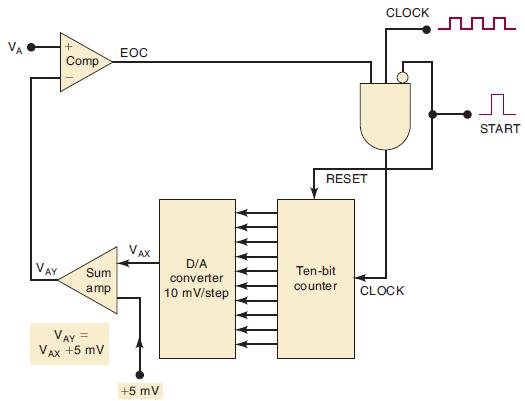
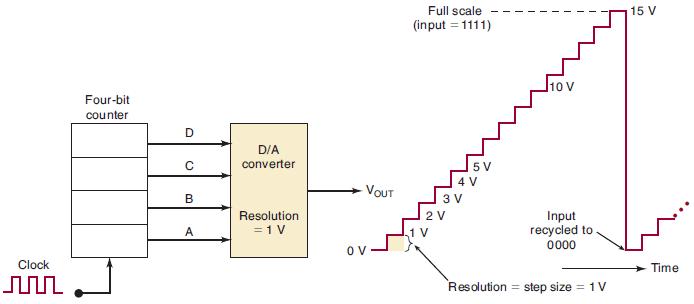
Figure 11-3
VAY Comp Sum amp VAY = VAX +5 mV EOC VAX +5 mV D/A converter 10 mV/step RESET Ten-bit counter CLOCK CLOCK START
Step by Step Solution
3.50 Rating (153 Votes )
There are 3 Steps involved in it
a The 10bit ADC has a resolution of 10 mVstep so the digital output for VA 5022 V is Digital output ... View full answer

Get step-by-step solutions from verified subject matter experts