







Question: Solve the problem P3.7 using the Laplace transformation technique. Problem P3.7 Consider the cantilever of the atomic force microscope (Binning and Quate, 1986) with length
Solve the problem P3.7 using the Laplace transformation technique.
Problem P3.7
Consider the cantilever of the atomic force microscope (Binning and Quate, 1986) with length \(=100 \mu \mathrm{m}\), thickness \(=0.8 \mu \mathrm{m}\), and width \(=20 \mu \mathrm{m}\). The material of the cantilever is silicon nitride having \(E=310 \times 10^{9} \mathrm{~Pa}\) and density \(=3.29 \mathrm{gm} / \mathrm{cc}\). A force \(f(t)\) is applied at the tip of the cantilever.
The force \(f(t)\) is as shown in Figure P3.7 for which \(P=1 \mu \mathrm{N}, Q=\) \(0.5 \mu \mathrm{N}, a=1 \mathrm{sec}, b=2 \mathrm{sec}, d=3 \mathrm{sec}\), and \(g=5 \mathrm{sec}\).
a. On the basis of an equivalent SDOF model, find the unit impulse response function for zero initial conditions. Assume the damping ratio \(=0.001\).
b. Using the convolution integral, determine \(x(t)\) for \(t>0\). Assume that \(x(0)=0.5 \mu \mathrm{m}\), and \(d x / d t=0\).
Using MATLAB, plot \(x(t)\) versus \(t\).
Figure P3.7
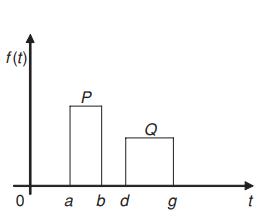
f(t) P 0 abd g t
Step by Step Solution
There are 3 Steps involved in it

Get step-by-step solutions from verified subject matter experts
 Study Help