







Question: 6.4 Using the regression results in column (3): a. Do there appear to be important regional differences? b. Why is the regressor West omitted from
6.4 Using the regression results in column (3):
a. Do there appear to be important regional differences?
b. Why is the regressor West omitted from the regression? What would happen if it were included?
c. Juanita is a 28-year-old female college graduate from the South. Jennifer is a 28-year-old female college graduate from the Midwest. Calculate the expected difference in earnings between Juanita and Jennifer.
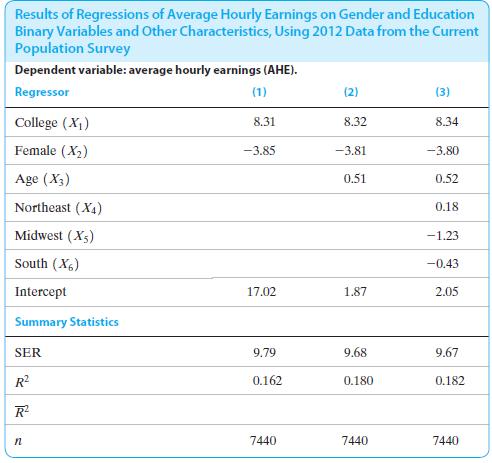
The data set consists of information on 7440 full-time, full-year workers. The highest educational achievement for each worker was either a high school diploma or a bachelor’s degree. The workers’
ages ranged from 25 to 34 years. The data set also contains information on the region of the country where the person lived, marital status, and number of children.
For the purposes of these exercises, let AHE = average hourly earnings (in 2012 dollars)
College = binary variable (1 if college, 0 if high school)
Female = binary variable (1 if female, 0 if male)
Age = age (in years)
Ntheast = binary variable (1 if Region = Northeast, 0 otherwise)
Midwest = binary variable (1 if Region = Midwest, 0 otherwise)
South = binary variable (1 if Region = South, 0 otherwise)
West = binary variable (1 if Region = West, 0 otherwise)
Results of Regressions of Average Hourly Earnings on Gender and Education Binary Variables and Other Characteristics, Using 2012 Data from the Current Population Survey Dependent variable: average hourly earnings (AHE). Regressor (1) (2) (3) College (X1) 8.31 8.32 8.34 Female (X2) -3.85 -3.81 -3.80 Age (X3) 0.51 0.52 Northeast (X4) 0.18 Midwest (X5) -1.23. South (X6) -0.43 Intercept 17.02 1.87 2.05 Summary Statistics SER 9.791 9.68 9.67 R 0.162 0.180 0.182 R n 7440 7440 7440
Step by Step Solution
There are 3 Steps involved in it

Get step-by-step solutions from verified subject matter experts
 Study Help