



Question: A researcher carries out a QLR test using (25 %) trimming, and there are (q=5) restrictions. Answer the following questions, using the values in Table
A researcher carries out a QLR test using \(25 \%\) trimming, and there are \(q=5\) restrictions. Answer the following questions, using the values in Table 15.5 and the \(F_{m, \infty}\) critical values in Appendix Table 4.
a. The QLR \(F\)-statistic is 4.2. Should the researcher reject the null hypothesis at the \(5 \%\) level?
b. The QLR F-statistic is 2.1. Should the researcher reject the null hypothesis at the \(5 \%\) level?
c. The QLR F-statistic is 3.5. Should the researcher reject the null hypothesis at the \(5 \%\) level?
Table 15.5
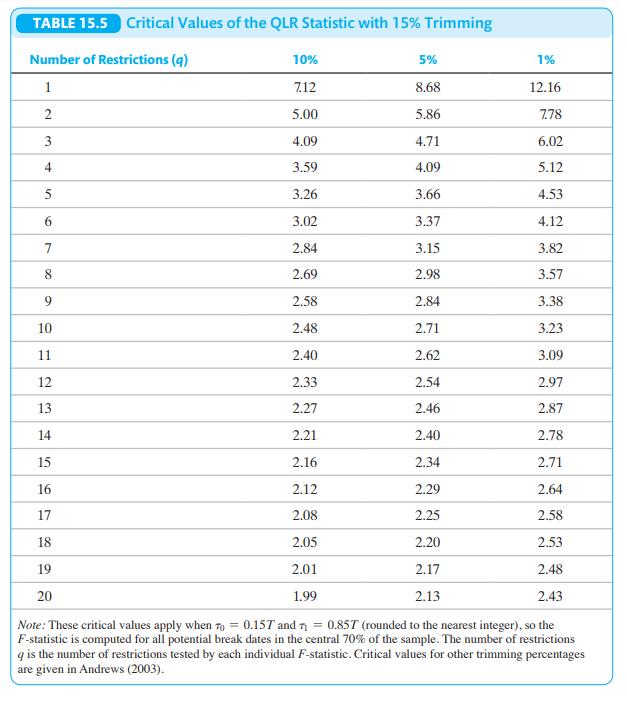
TABLE 15.5 Critical Values of the QLR Statistic with 15% Trimming Number of Restrictions (q) 1 10% 5% 1% 7.12 8.68 12.16 2 5.00 5.86 7.78 3 4.09 4.71 6.02 4 3.59 4.09 5.12 5 3.26 3.66 4.53 6 3.02 3.37 4.12 7 2.84 3.15 3.82 8 2.69 2.98 3.57 9 2.58 2.84 3.38 10 2.48 2.71 3.23 11 2.40 2.62 3.09 12 2.33 2.54 2.97 13 2.27 2.46 2.87 14 2.21 2.40 2.78 15 2.16 2.34 2.71 16 2.12 2.29 2.64 17 2.08 2.25 2.58 18 2.05 2.20 2.53 19 2.01 2.17 2.48 20 1.99 2.13 2.43 Note: These critical values apply when 70 = 0.157 and 0.857 (rounded to the nearest integer), so the F-statistic is computed for all potential break dates in the central 70% of the sample. The number of restrictions q is the number of restrictions tested by each individual F-statistic. Critical values for other trimming percentages are given in Andrews (2003).
Step by Step Solution
3.34 Rating (154 Votes )
There are 3 Steps involved in it

Get step-by-step solutions from verified subject matter experts