







Question: Assuming that Y and X 2 , X 3 , . . . , X k are jointly normally distributed and assuming that the null
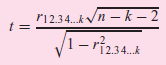
follows the t distribution with n ˆ’ k ˆ’ 2 df, where k is the kth-order partial correlation coefficient and where n is the total number of observations. (r1 2.3 is a firstorder partial correlation coefficient, r1 2.3 4 is a second-order partial correlation coefficient, and so on.) Refer to Exercise 7.2. Assuming Y and X2 and X3 to be jointly normally distributed, compute the three partial correlations r1 2.3, r1 3.2, and r2 3.1 and test their significance under the hypothesis that the corresponding population correlations are individually equal to zero.
'n k 2 P12.34.k/n - k - 2 t = |1 r2,34.k
Step by Step Solution
3.31 Rating (160 Votes )
There are 3 Steps involved in it
Using Equation 358 the reader can verify that r 12 09989 r 13 09885 and r 23 098... View full answer

Get step-by-step solutions from verified subject matter experts
Document Format (2 attachments)

1529_605d88e1ce136_656265.pdf
180 KBs PDF File

1529_605d88e1ce136_656265.docx
120 KBs Word File
 Study Help