







Question: Explicitly show that the stress state given in Example 3.1 will reduce to the proper diagonal form under transformation to principal axes. Data from example
Explicitly show that the stress state given in Example 3.1 will reduce to the proper diagonal form under transformation to principal axes.
Data from example 3.1
For the following state of stress, determine the principal stresses and directions and find the traction vector on a plane with unit normal n = (0, 1, 1)/ √2:
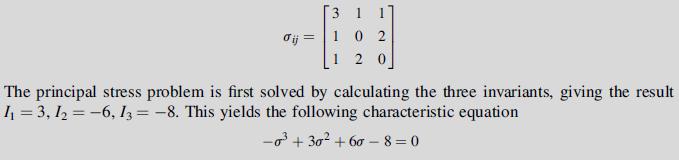
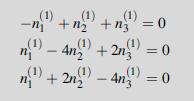
The roots of this equation are found to be σ = 4, 1, –2. Back substituting the first root into the fundamental system [see (1.6.1)] gives:
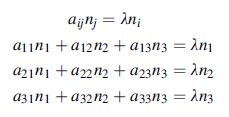
Equation 1.6.1
Solving this system, the normalized principal direction is found to be n (1) = (2, 1, 1)/ √6. In similar fashion the other two principal directions are n (2) = (–1, 1, 1)/ √3, n (3) = (0, –1, 1)/ √2. The traction vector on the specified plane is calculated by using the relation:
![3 T = 1 0 2 1 20 1/2 [1/] = [2/2 2/2 2/2](https://dsd5zvtm8ll6.cloudfront.net/images/question_images/1704/8/7/4/727659e52e75fc851704874726294.jpg)
dij 1 0 2 120 The principal stress problem is first solved by calculating the three invariants, giving the result 1 = 3, 1 = 6, 13 = -8. This yields the following characteristic equation -0 +30 +60-8=0
Step by Step Solution
3.53 Rating (146 Votes )
There are 3 Steps involved in it
3 1 1 1 0 2 is the given stress matrix and using the previously ... View full answer

Get step-by-step solutions from verified subject matter experts
 Study Help