







Question: 1.14. Let {Xn, n E NO} be an independent process. Let s(r+l) n j=O for r > 1. Then {S~), n E NO} has the
1.14. Let {Xn, n E NO} be an independent process. Let
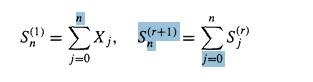 s(r+l)
n j=O for r > 1. Then {S~), n E NO} has the rth-order Markov property. For r = 2, give an example to show that it need not be a Markov process.
== j=0 n S(+1) = S =0
Step by Step Solution
There are 3 Steps involved in it
1 Expert Approved Answer
Step: 1 Unlock

Question Has Been Solved by an Expert!
Get step-by-step solutions from verified subject matter experts
Step: 2 Unlock
Step: 3 Unlock
 Study Help