



Question: Consider the model from section 12.4.4. (a) Derive the second-best optimal combination of an emission tax and import tariff (export tax) for the case when
Consider the model from section 12.4.4.
(a) Derive the second-best optimal combination of an emission tax and import tariff (export tax) for the case when there is no transboundary pollution.
(b) Derive the comparative static effects of an import tariff (export tax) increase.
(c) Assume now that the foreign country has issued tradable permits to regulate emissions, and repeat
(a) and (b).
(d) Assume now that there is transboundary pollution. Derive the second-best optimal combination of an emission tax and import tariff (export tax).
Data from section 12.4.4
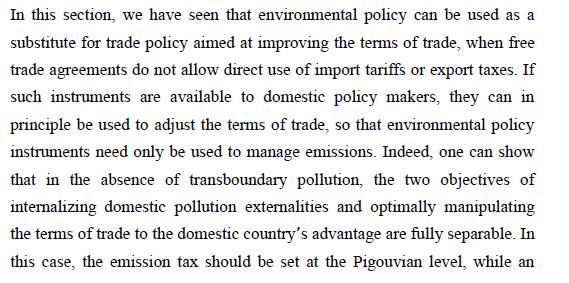
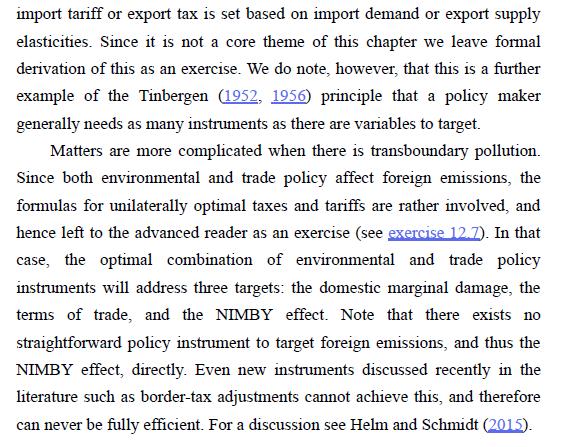
In this section, we have seen that environmental policy can be used as a substitute for trade policy aimed at improving the terms of trade, when free trade agreements do not allow direct use of import tariffs or export taxes. If such instruments are available to domestic policy makers, they can in principle be used to adjust the terms of trade, so that environmental policy instruments need only be used to manage emissions. Indeed, one can show that in the absence of transboundary pollution, the two objectives of internalizing domestic pollution externalities and optimally manipulating the terms of trade to the domestic country's advantage are fully separable. In this case, the emission tax should be set at the Pigouvian level, while an
Step by Step Solution
3.53 Rating (153 Votes )
There are 3 Steps involved in it
a SecondBest Optimal Combination of Emission Tax and Import Tariff In the absence of transboundary pollution the secondbest optimal combination of an ... View full answer

Get step-by-step solutions from verified subject matter experts