



Question: Modify the problem in example 4.2 by considering an increasing marginal damage function of type D(E)= dE 2 /2 (a) Modify the example by assuming
Modify the problem in example 4.2 by considering an increasing marginal damage function of type D(E)= dE2/2
(a) Modify the example by assuming that there are K firms of type L and J−K firms of type H.
(b) Assume now that there are three types of firm with a number K of type L firms, a number N of type M (medium cost) firms, and J−K−N firms of type H, with S L MH Derive the second-best optimal emission and fee scheme. Show that only the participation constraint of the H-type firm is binding, and that for both the L-type and the M-type firm only one of the incentive constraints is binding. Which one is it?
Data from example 4.2
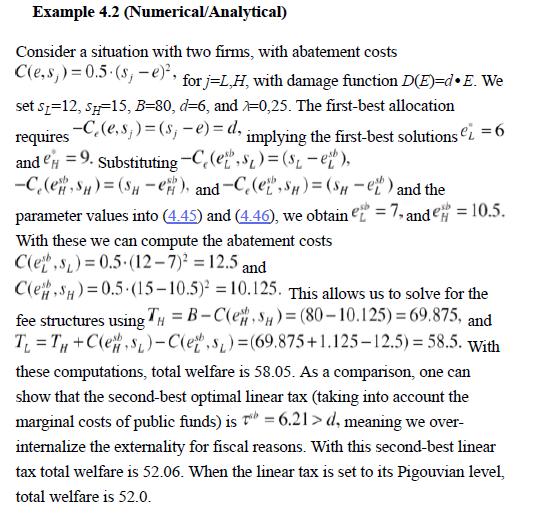

Example 4.2 (Numerical/Analytical) Consider a situation with two firms, with abatement costs C(e,s,)=0.5-(s, -e), for j=L,H, with damage function D(E)=d. E. We set SL-12, SH-15, B-80, d-6, and =0,25. The first-best allocation requires -C, (e,s;)=(s, -e)=d,, implying the first-best solutions L = 6 and H=9. Substituting-C, (es)=(S-et), -C, (e,SH)=(SH-CH) and C (SH)=(SH-CL) and the parameter values into (4.45) and (4.46), we obtain et = 7, and e# = 10.5. With these we can compute the abatement costs C(es)=0.5 (12-7) = 12.5 and C(SH) 0.5-(15-10.5) =10.125. This allows us to solve for the fee structures using TH=B-C(eSH)=(80-10.125)=69.875, and T=T + C(es)-C(es)=(69.875+1.125-12.5)=58.5. With these computations, total welfare is 58.05. As a comparison, one can show that the second-best optimal linear tax (taking into account the marginal costs of public funds) is = 6.21 > d, meaning we over- internalize the externality for fiscal reasons. With this second-best linear tax total welfare is 52.06. When the linear tax is set to its Pigouvian level, total welfare is 52.0.
Step by Step Solution
3.43 Rating (156 Votes )
There are 3 Steps involved in it
The problem presented in the images describes a scenario with two firms L lowcost firm and H highcost firm facing different abatement costs for pollution and a quadratic damage function from emission ... View full answer

Get step-by-step solutions from verified subject matter experts