







Question: 31. A psychologist is interested in determining whether left-handed and right-handed people differ in spatial ability. She randomly selects 10 left-handers and 10 right-handers from
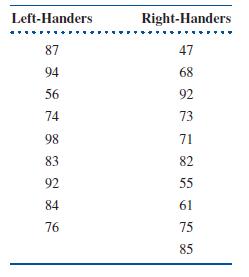
31. A psychologist is interested in determining whether left-handed and right-handed people differ in spatial ability. She randomly selects 10 left-handers and 10 right-handers from the students enrolled in the university where she works and administers a test that measures spatial ability. The following are the scores (a higher score indicates better spatial ability). Note that one of the subjects did not show up for the testing.
a. What is the alternative hypothesis? Use a nondirectional hypothesis.
b. What is the null hypothesis?
c. Using the Mann–Whitney U test and 0.052 tail, what do you conclude? cognitive
Left-Handers Right-Handers 87 47 94 68 56 92 74 73 98 71 83 82 92 55 84 61 76 75 85
Step by Step Solution
There are 3 Steps involved in it

Get step-by-step solutions from verified subject matter experts
 Study Help