







Question: After completing a course in database management, you are asked to develop a preliminary ERD for a symphony orchestra. You discover the entity types that
After completing a course in database management, you are asked to develop a preliminary ERD for a symphony orchestra. You discover the entity types that should be included as shown in Table 2-2. During further discussions you discover the following:
- A concert season schedules one or more concerts. A particular concert is scheduled for only one concert season.
- A concert includes the performance of one or more compositions. A composition may be performed at one or more concerts or may not be performed.
- For each concert there is one conductor. A conductor may conduct any number of concerts or may not conduct any concerts.
- Each composition may require one or more soloists or may not require a soloist. A soloist may perform one or more compositions at a given concert or may not perform any composition. The symphony orchestra wishes to record the date when a soloist last performed a given composition (Date Last Performed).
Draw an ERD to represent what you have discovered. Identify a business rule in this description and explain how this business rule is modeled on the E-R diagram. Also draw a data model for this situation using the tool you have been told to use in your course.
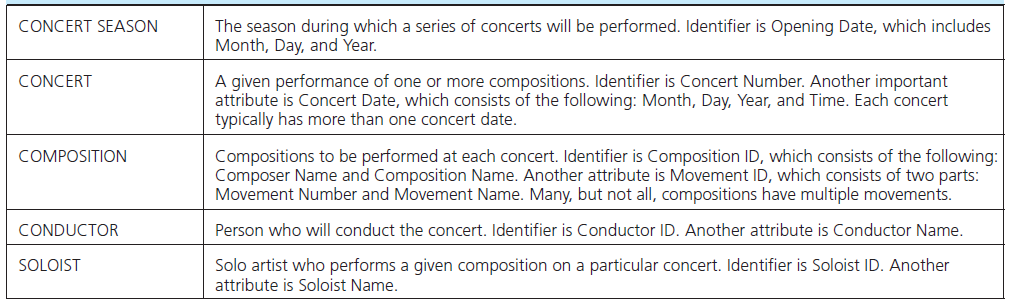
CONCERT SEASON The season during which a series of concerts will be performed. Identifier is Opening Date, which includes Month, Day, and Year. A given performance of one or more compositions. Identifier is Concert Number. Another important attribute is Concert Date, which consists of the following: Month, Day, Year, and Time. Each concert typically has more than one concert date. CONCERT COMPOSITION Compositions to be performed at each concert. Identifier is Composition ID, which consists of the following: Composer Name and Composition Name. Another attribute is Movement ID, which consists of two parts: Movement Number and Movement Name. Many, but not all, compositions have multiple movements. Person who will conduct the concert. Identifier is Conductor ID. Another attribute is Conductor Name. CONDUCTOR Solo artist who performs a given composition on attribute is Soloist Name. a particular concert. Identifier is Soloist ID. Another SOLOIST
Step by Step Solution
3.58 Rating (151 Votes )
There are 3 Steps involved in it
Business Rule A concert includes the performance of one or more compositions a composition may be pe... View full answer

Get step-by-step solutions from verified subject matter experts
 Study Help