







Question: How does the joint production possibility frontier for Jane and Denise in panel c of Figure 10.6 change if they can also trade with Harvey,
How does the joint production possibility frontier for Jane and Denise in panel c of Figure 10.6 change if they can also trade with Harvey, who can produce 5 cords of wood, 5 candy bars, or any linear combination of wood and candy in a day?
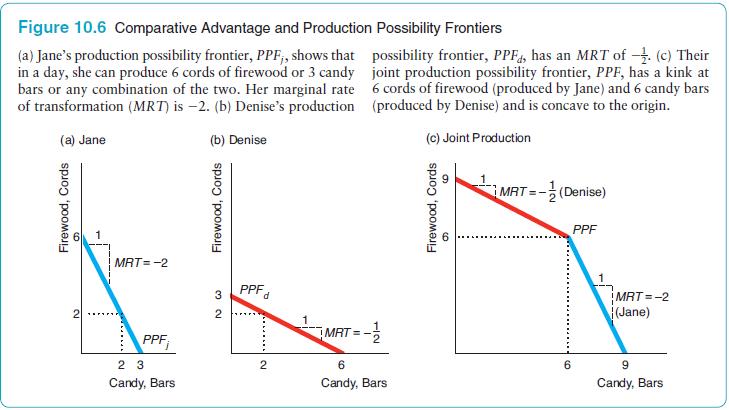
Figure 10.6 Comparative Advantage and Production Possibility Frontiers (a) Jane's production possibility frontier, PPF,, shows that in a day, she can produce 6 cords of firewood or 3 candy bars or any combination of the two. Her marginal rate of transformation (MRT) is -2. (b) Denise's production (a) Jane (b) Denise possibility frontier, PPF, has an MRT of . (c) Their joint production possibility frontier, PPF, has a kink at 6 cords of firewood (produced by Jane) and 6 candy bars (produced by Denise) and is concave to the origin. (c) Joint Production Firewood, Cords 2 MRT=-2 PPF 2 3 Candy, Bars Firewood, Cords 32 PPF d 1 MRT= Firewood, Cords 6 MRT=-(Denise) 2 6 6 Candy, Bars PPF MRT=-2 (Jane) 9 Candy, Bars
Step by Step Solution
There are 3 Steps involved in it

Get step-by-step solutions from verified subject matter experts
 Study Help