







Question: Consider the following variation of the Stack class defined in Listing 10.10: // stack.h -- class declaration for the stack ADT typedef unsigned long Item;
Consider the following variation of the Stack class defined in Listing 10.10:
// stack.h -- class declaration for the stack ADT
typedef unsigned long Item;
class Stack
{
private:
enum {MAX = 10}; // constant specific to class
Item * pitems; // holds stack items
int size; // number of elements in stack
int top; // index for top stack item
public:
Stack(int n = MAX); // creates stack with n elements
Stack(const Stack & st);
~Stack();
bool isempty() const;
bool isfull() const;
// push() returns false if stack already is full, true otherwise
bool push(const Item & item); // add item to stack
// pop() returns false if stack already is empty, true otherwise
bool pop(Item & item); // pop top into item
Stack & operator=(const Stack & st);
};
As the private members suggest, this class uses a dynamically allocated array to hold the stack items. Rewrite the methods to fit this new representation and write a program that demonstrates all the methods, including the copy constructor and assignment operator.
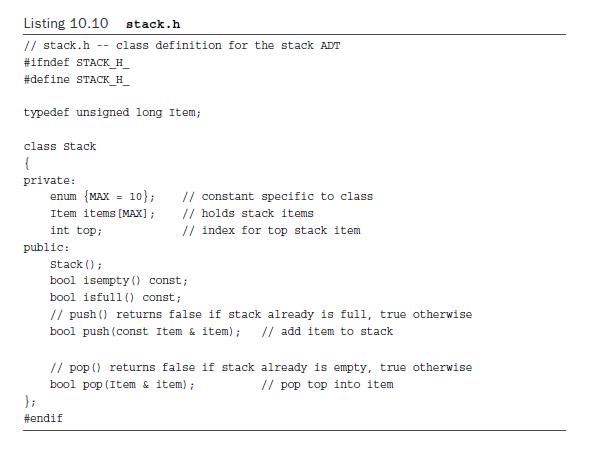
Listing 10.10 stack.h // stack.h class definition for the stack ADT #ifndef STACK_H_ #define STACK_H_ typedef unsigned long Item; class Stack { private: enum {MAX = 10); Item items [MAX]; int top; public: // constant specific to class // holds stack items // index for top stack item stack(); bool isempty() const; bool isfull () const; // push() returns false if stack already is full, true otherwise bool push (const Item & item); // add item to stack // pop () returns false if stack already is empty, true otherwise bool pop (Item & item); // pop top into item. }; #endif
Step by Step Solution
3.39 Rating (155 Votes )
There are 3 Steps involved in it
include include include using namespace std typedef unsigned long Item class Stack private enum MAX ... View full answer

Get step-by-step solutions from verified subject matter experts
 Study Help