







Question: Although keys in a map are distinct, the binary search algorithm can be applied in a more general setting in which an array stores possibly
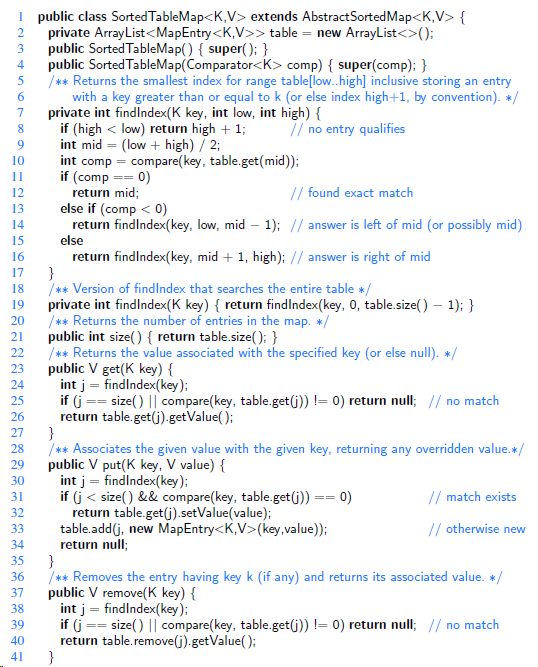
public class Sorted TableMap extends AbstractSortedMap { private ArrayList table public Sorted TableMap() { super(); } public Sorted TableMap(Comparator comp) { super(comp); } /** Returns the smallest index for range table[low.high] inclusive storing an entry with a key greater than or equal to k (or else index high+1, by convention). */ private int findIndex(K key, int low, int high) { if (high < low) return high + 1; int mid = (low + high) / 2; int comp = compare(key, table.get(mid)); if (comp == 0) return mid; else if (comp < 0) return findlndex(key, low, mid 1); // answer is left of mid (or possibly mid) else new ArrayList ((); // no entry qualifies 10 11 // found exact match 12 13 14 15 return findlndex(key, mid + 1, high); // answer is right of mid } /** Version of findIndex that searches the entire table */ private int findlndex(K key) { return findIndex(key, 0, table.size() 1); } /** Returns the number of entries in the map. */ public int size() { return table.size(); } /** Returns the value associated with the specified key (or else null). */ public V get(K key) { int j = findlndex(key); if (j == size() || compare(key, table.get(j)) != 0) return null; // no match return table.get(j).getValue( ); 16 17 18 19 20 21 22 23 24 25 26 27 /** Associates the given value with the given key, returning any overridden value.*/ public V put(K key, V value) { int j = findlndex(key); if (j < size() && compare(key, table.get(j)) == 0) return table.get(j).setValue(value); table.add(j, new MapEntry (key, value)); return null; } /** Removes the entry having key k (if any) and returns its associated value. */ public V remove(K key) { int j = findlndex(key); if (j == size() || compare(key, table.get(j)) != 0) return null; // no match return table.remove(j).getValue(); } 28 29 30 // match exists 31 32 // otherwise new 33 34 35 36 37 38 39 40 41
Step by Step Solution
3.38 Rating (170 Votes )
There are 3 Steps involved in it
The original version of Code Fragment 1011 does not guarantee that it finds the leftmost occ... View full answer

Get step-by-step solutions from verified subject matter experts
 Study Help