







Question: Some authors define ? in a slightly different way than we do; let?s use ? ? (read ?omega infinity?) for this alternative definition. We say
Some authors define ? in a slightly different way than we do; let?s use ??(read ?omega infinity?) for this alternative definition. We say that f (n) = ?? (g(n)) if there exists a positive constant c such that f (n) ? cg(n) ? 0 for infinitely many integers n.
a. Show that for any two functions f (n) and g(n) that are asymptotically nonnegative, either f (n) = O(g(n)) or f (n) = ?? (g(n)) or both, whereas this is not true if we use ? in place of ??.
b. Describe the potential advantages and disadvantages of using ?? instead of ? to characterize the running times of programs.
Some authors also define O in a slightly different manner; let?s use O? for the alternative definition. We say that f (n) = O? (g(n)) if and only if |f (n)| = O(g(n)).
c. What happens to each direction of the ?if and only if? in Theorem 3.1 if we substitute O? for O but still use ??
Some authors define O? (read ?soft-oh?) to mean O with logarithmic factors ignored:
O?(g(n)) = {f (n) : there exist positive constants c, k, and n0 such that 0 ? f (n) ? cg(n) lgk(n) for all n ? n0}.
d. Define ?? and ??? in a similar manner. Prove the corresponding analog to Theorem 3.1.
Theorem 3.1
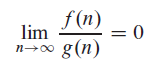
f (n) lim = 0 g(n) n00
Step by Step Solution
3.44 Rating (163 Votes )
There are 3 Steps involved in it

Get step-by-step solutions from verified subject matter experts
Document Format (2 attachments)

1778_61d57f25d5396_819366.pdf
180 KBs PDF File

1778_61d57f25d5396_819366.docx
120 KBs Word File
 Study Help