







Question: Rosanne McIntire is a consultant to Georgia Paper Products Company. She is helping one of the companys divisions to install a standard cost system for
Rosanne McIntire is a consultant to Georgia Paper Products Company. She is helping one of the company’s divisions to install a standard cost system for 20X0. For product-costing purposes, the system must apply fixed factory costs to products manufactured. She has decided that the fixed-overhead rate should be based on machine hours, but she is uncertain about the appropriate volume to use in the denominator. Georgia Paper has grown rapidly; the division has added production capacity approximately every 4 years. The last addition was completed in early 20X0, and the total capacity is now 2,800,000 machine hours per year. McIntire predicts the following operating levels (in machine hours) through 20X4:
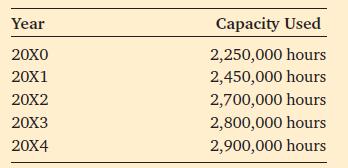
The current plan is to add another 500,000 machine hours of capacity in 20X4. McIntire has identified three alternatives for the application base:
(a). Predicted volume for the year in question.
(b). Average volume over the 4 years of the current production setup
(c) Practical (or full) capacity.
1. Suppose annual fixed factory overhead is expected to be €36,400,000 through 20X3. For simplicity, assume no inflation. Calculate the fixed-overhead rates (to the nearest cent) for 20X1, 20X2 and 20X3, using each of the three alternative application bases.
2. Provide a brief description of the effect of using each method of computing the application base.
3. Which method do you prefer? Why?
Year 20X0 20X1 20X2 20X3 20X4 Capacity Used 2,250,000 hours 2,450,000 hours 2,700,000 hours 2,800,000 hours 2,900,000 hours
Step by Step Solution
3.34 Rating (157 Votes )
There are 3 Steps involved in it
1 To calculate the fixedoverhead rates for 20X1 20X2 and 20X3 using each of the three alternative application bases a Predicted volume for the year in ... View full answer

Get step-by-step solutions from verified subject matter experts
 Study Help