







Question: The beck exploit. A popular web server supports a function named no2s7ash() whose purpose is to collapse multiple / characters. For example, the string /d1///d2////d3/test.
The "beck" exploit. A popular web server supports a function named no2s7ash() whose purpose is to collapse multiple / characters. For example, the string /d1///d2////d3/test. htm1 collapses to \(/ \mathrm{d} 1 / \mathrm{d} 2 / \mathrm{d} 3 /\) test. htm 1 . The original algorithm was to repeatedly search for a / and copy the remainder of the string:
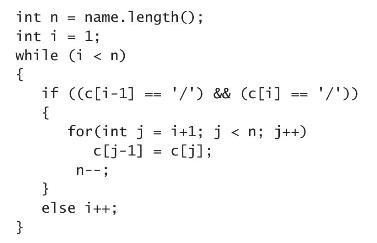
Unfortunately, this code can takes quadratic time (for example, if the string consists of the / character repeated \(\mathrm{n}\) times). By sending multiple simultaneous requests with large numbers of / characters, a hacker could deluge the server and starve other processes for CPU time, thereby creating a denial-of-service attack. Develop a version of no2s7ash() that runs in linear time and does not allow for this type of attack.
int n = name. length(); int i 1; while (i
Step by Step Solution
3.48 Rating (151 Votes )
There are 3 Steps involved in it
The code snippet provided in the image is a naive implementation to collapse multiple characters into a single because it involves shifting the remain... View full answer

Get step-by-step solutions from verified subject matter experts
 Study Help