







Question: In this exercise, we discuss deleting items from binary search trees. The deletion algorithm is not as straightforward as the insertion algorithm. Three cases are
In this exercise, we discuss deleting items from binary search trees. The deletion algorithm is not as straightforward as the insertion algorithm. Three cases are encountered when deleting an item—the item is contained in a leaf node (i.e., it has no children), or in a node that has one child or in a node that has two children.
If the item to be deleted is contained in a leaf node, the node is deleted and the reference in the parent node is set to null. If the item to be deleted is contained in a node with one child, the reference in the parent node is set to reference the child node and the node containing the data item is deleted. This causes the child node to take the place of the deleted node in the tree.
The last case is the most difficult. When a node with two children is deleted, another node in the tree must take its place. However, the reference in the parent node cannot simply be assigned to reference one of the children of the node to be deleted. In most cases, the resulting binary search tree would not embody the following characteristic of binary search trees (with no duplicate values):
The values in any left subtree are less than the value in the parent node, and the values in any right subtree are greater than the value in the parent node.
Which node is used as a replacement node to maintain this characteristic? It’s either the node containing the largest value in the tree less than the value in the node being deleted, or the node containing the smallest value in the tree greater than the value in the node being deleted. Let’s consider the node with the smaller value. In a binary search tree, the largest value less than a parent’s value is located in the left subtree of the parent node and is guaranteed to be contained in the rightmost node of the subtree. This node is located by walking down the left subtree to the right until the reference to the right child of the current node is null. We’re now referencing the replacement node, which is either a leaf node or a node with one child to its left. If the replacement node is a leaf node, the steps to perform the deletion are as follows:
a) Store the reference to the node to be deleted in a temporary reference variable.
b) Set the reference in the parent of the node being deleted to reference the replacement node.
c) Set the reference in the parent of the replacement node to null.
d) Set the reference to the right subtree in the replacement node to reference the right subtree of the node to be deleted.
e) Set the reference to the left subtree in the replacement node to reference the left subtree of the node to be deleted.
The deletion steps for a replacement node with a left child are similar to those for a replacement node with no children, but the algorithm also must move the child into the replacement node’s position in the tree. If the replacement node is a node with a left child, the steps to perform the deletion are as follows:
a) Store the reference to the node to be deleted in a temporary reference variable.
b) Set the reference in the parent of the node being deleted to refer to the replacement node.
c) Set the reference in the parent of the replacement node to reference the left child of the replacement node.
d) Set the reference to the right subtree in the replacement node to reference the right subtree of the node to be deleted.
e) Set the reference to the left subtree in the replacement node to reference the left subtree of the node to be deleted.
Write method deleteNode, which takes as its argument the value to delete. Method delete-Node should locate in the tree the node containing the value to delete and use the algorithms discussed here to delete the node. If the value is not found in the tree, the method should display a message saying so. Modify the program of Figs. 21.15 and 21.16 to use this method. After deleting an item, call the methods inorderTraversal, preorderTraversal and postorderTraversal to confirm that the delete operation was performed correctly.
Fig. 21.15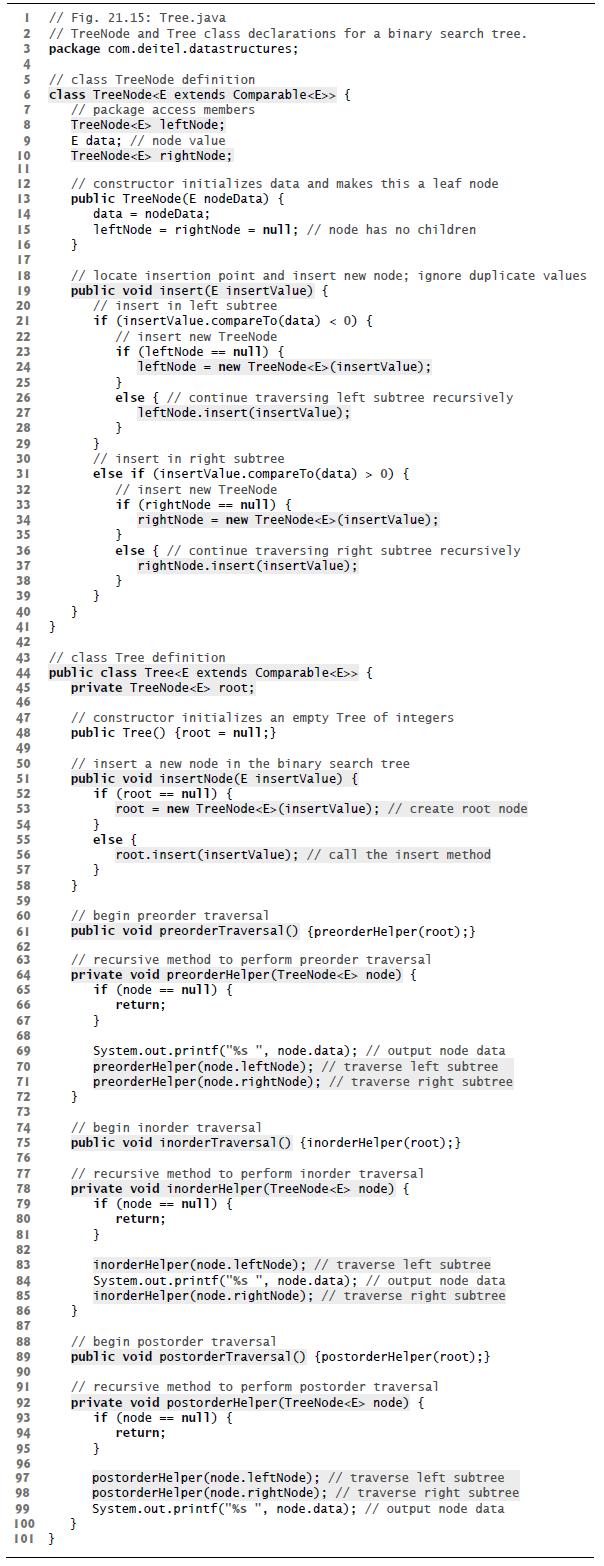
Fig. 21.16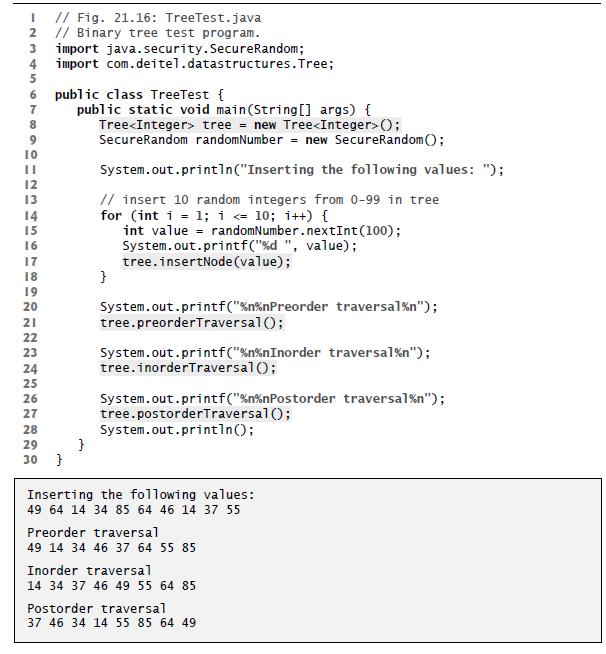
I // Fig. 21.15: Tree.java 2 // TreeNode and Tree class declarations for a binary search tree. 3 package com.deitel.datastructures; 4 5 // class TreeNode definition 6 class TreeNode { 7 8 9 10 IL 12 13 14 15 16 17 18 19 20 21 22 23 24 25 26 27 28 29 30 31 32 33 34 35 36 37 38 39 40 41 } 42 44 45 46 47 48 49 50 51 52 53 54 55 56 57 58 59 60 61 62 63 64 65 66 67 68 69 70 71 72 73 74 75 76 77 78 79 80 81 82 83 84 85 86 87 88 89 90 91 92 93 94 95 96 97 98 // package access members TreeNode leftNode; 99 100 101 } E data; // node value TreeNode rightNode; // constructor initializes data and makes this a leaf node public TreeNode (E nodeData) { data nodeData; leftNode= rightNode = null; // node has no children } // locate insertion point and insert new node; ignore duplicate values public void insert (E insertValue) { // insert in left subtree } if (insertValue.compareTo (data) < 0) { // insert new TreeNode } } if (leftNode == null) { leftNode = new TreeNode (insertValue); } else { // continue traversing left subtree recursively leftNode.insert(insertValue); } // insert in right subtree else if (insertValue.compareTo (data) > 0) { // class Tree definition public class Tree { private TreeNode root; } // constructor initializes an empty Tree of integers public Tree()) {root = null;} // insert new TreeNode. if (rightNode == null) { rightNode = new TreeNode (insertValue); } else { // continue traversing right subtree recursively rightNode.insert(insertValue); } // insert a new node in the binary search tree public void insertNode (E insertValue) { if (root == null) { root = new TreeNode (insertValue); // create root node } } } else { root.insert(insertValue); // call the insert method // begin preorder traversal public void preorderTraversal() {preorderHelper (root); } // recursive method to perform preorder traversal private void preorderHelper (TreeNode node) { if (node == null) { return; } System.out.printf("%s", node.data); // output node data preorderHelper (node.leftNode); // traverse left subtree preorderHelper (node.rightNode); // traverse right subtree } // begin inorder traversal public void inorderTraversal() {inorderHelper (root); } // recursive method to perform inorder traversal private void inorderHelper (TreeNode node) { if (node == null) { return; } inorderHelper (node.leftNode); // traverse left subtree System.out.printf("%s ", node.data); // output node data inorderHelper (node.rightNode); // traverse right subtree } // begin postorder traversal public void postorderTraversal() [postorderHelper (root); } // recursive method to perform postorder traversal private void postorderHelper (TreeNode node) { if (node == null) { return; } postorderHelper (node.leftNode); // traverse left subtree postorderHelper (node.rightNode); // traverse right subtree System.out.printf("%s", node.data); // output node data
Step by Step Solution
3.44 Rating (157 Votes )
There are 3 Steps involved in it
Based on the provided question and images you need to implement the deleteNode method in the Tree class which will manage the deletion of a node from a binary search tree while maintaining the binary ... View full answer

Get step-by-step solutions from verified subject matter experts
 Study Help