







Question: In this problem, youll re-create the classic race of the tortoise and the hare. Youll use random-number generation to develop a simulation of this memorable
In this problem, you’ll re-create the classic race of the tortoise and the hare. You’ll use random-number generation to develop a simulation of this memorable event.
Our contenders begin the race at square 1 of 70 squares. Each square represents a possible position along the race course. The finish line is at square 70. The first contender to reach or pass square 70 is rewarded with a pail of fresh carrots and lettuce. The course weaves its way up the side of a slippery mountain, so occasionally the contenders lose ground.
A clock ticks once per second. With each tick of the clock, your application should adjust the position of the animals according to the rules in Fig. 6.22. Use variables to keep track of the positions of the animals (i.e., position numbers are 1–70). Start each animal at position 1 (the “starting gate”). If an animal slips left before square 1, move it back to square 1.
Fig. 6.22
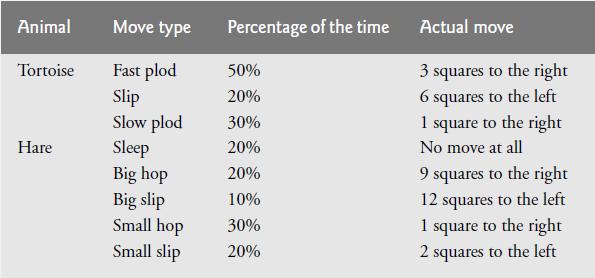
Generate the percentages in Fig. 6.22 by producing a random integer i in the range 1 ≤ i ≤ 10. For the tortoise, perform a “fast plod” when 1 ≤ i ≤ 5, a “slip” when 6 ≤ i ≤ 7 or a “slow plod” when 8 ≤ i ≤ 10. Use a similar technique to move the hare.
Begin the race by displaying
BANG !!!!!
AND THEY'RE OFF !!!!!
Then, for each tick of the clock (i.e., each iteration of a loop), display a 70-position line showing the letter T in the position of the tortoise and the letter H in the position of the hare. Occasionally, the contenders will land on the same square. In this case, the tortoise bites the hare, and your application should display OUCH!!! beginning at that position. All output positions other than the T, the H or the OUCH!!! (in case of a tie) should be blank.
After each line is displayed, test for whether either animal has reached or passed square 70. If so, display the winner and terminate the simulation. If the tortoise wins, display TORTOISE WINS!!! YAY!!! If the hare wins, display Hare wins. Yuch. If both animals win on the same tick of the clock, you may want to favor the tortoise (the “underdog”), or you may want to display It's a tie. If neither animal wins, perform the loop again to simulate the next tick of the clock. When you’re ready to run your application, assemble a group of fans to watch the race. You’ll be amazed at how involved your audience gets!
Later in the book, we introduce a number of Java capabilities, such as graphics, images, animation, sound and multithreading. As you study those features, you might enjoy enhancing your tortoise-and-hare contest simulation.
Animal Tortoise Hare Move type Fast plod Slip Slow plod Sleep Big hop Big slip Small hop Small slip Percentage of the time 50% 20% 30% 20% 20% 10% 30% 20% Actual move 3 squares to the right 6 squares to the left 1 square to the right No move at all 9 squares to the right 12 squares to the left 1 square to the right 2 squares to the left
Step by Step Solution
There are 3 Steps involved in it
Based on the provided race details and the move types with their corresponding percentages and actua... View full answer

Get step-by-step solutions from verified subject matter experts
 Study Help