







Question: Exercises 11 through 20 provide a statement, its truth value in parentheses, and a new statement. Determine how the new statement was derived from the
Exercises 11 through 20 provide a statement, its truth value in parentheses, and a new statement. Determine how the new statement was derived from the given statement and supply the truth value of the new statement. Take the Aristotelian standpoint in working these exercises and assume that the terms refer to actually existing things.
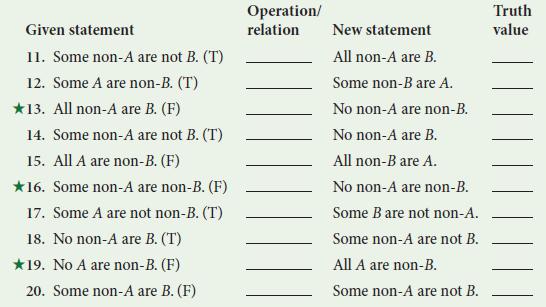
Given statement 11. Some non-A are not B. (T) 12. Some A are non-B. (T) *13. All non-A are B. (F) 14. Some non-A are not B. (T) 15. All A are non-B. (F) 16. Some non-A are non-B. (F) 17. Some A are not non-B. (T) 18. No non-A are B. (T) *19. No A are non-B. (F) 20. Some non-A are B. (F) Operation/ relation New statement All non-A are B. Some non-B are A. No non-A are non-B. No non-A are B. All non-B are A. No non-A are non-B. Some B are not non-A. Some non-A are not B. All A are non-B. Some non-A are not B. Truth value
Step by Step Solution
There are 3 Steps involved in it

Get step-by-step solutions from verified subject matter experts
 Study Help