







Question: The window through which the beam emerges from a high-powered laser must obviously be transparent to light. Even then, some of the energy of the
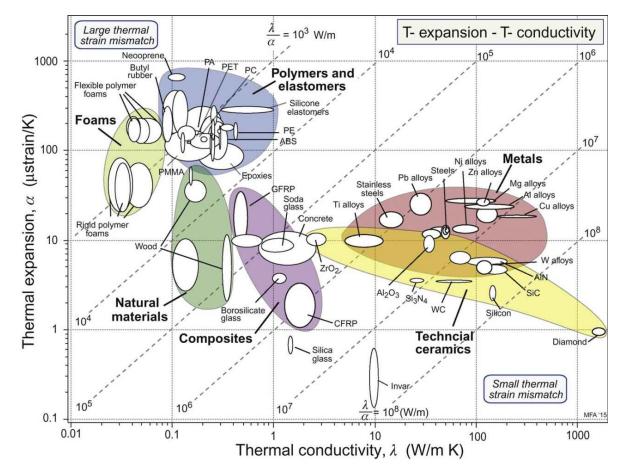
The window through which the beam emerges from a high-powered laser must obviously be transparent to light. Even then, some of the energy of the beam is absorbed in the window and can cause it to heat and crack. This problem is minimized by choosing a window material with a high thermal conductivity \(\lambda\) (to conduct the heat away) and a low expansion coefficient \(\alpha\) (to reduce thermal strains), that is, by seeking a window material with a high value of
\[M=\lambda / \alpha\]
Use the \(\alpha-\lambda\) chart of Fig. 3.12 to identify the best material for an ultra-high powered laser window.
Fig. 3.12
Thermal expansion, a (ustrain/K) 1000 Large thermal strain mismatch Neooprene PA Butyl rubber 100 100 Flexible polymer foams Foams Rigid polymer foams Wood 104 0.1 0.01 105 a =103 W/m PET PC, Polymers and elastomers Silicone elastomers P ABS 104 PMMA Epoxies GFRP Stainless steels Soda glass Ti alloys Concrete Natural materials Borosilicate glass Composites 106 107 0.1 CFRP T- expansion - T-conductivity 105 106 107 Steels Pb alloys Nj alloys Metals Zn alloys, Al2O3 Na WC Techncial ceramics Silica glass, Invar 10% (W/m) 10 Thermal conductivity, (W/m K) 100 Mg alloys Al alloys Cu alloys SIC Silicon Wafloys Diamond- 108 Small thermal strain mismatch MFA 15 1000
Step by Step Solution
3.48 Rating (148 Votes )
There are 3 Steps involved in it

Get step-by-step solutions from verified subject matter experts
 Study Help