







Question: Do Problem 17-36 using the FIFO method of process costing. If you did Problem 17-36, explain any difference between the cost of work completed and
Do Problem 17-36 using the FIFO method of process costing. If you did Problem 17-36, explain any difference between the cost of work completed and transferred out and the cost of ending work in process in the assembly department under the weighted-average method and the FIFO method.
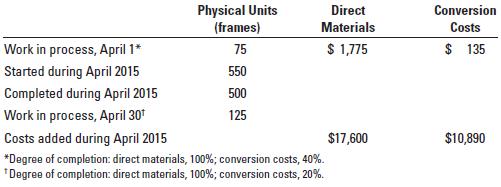
Data From Exercise 17-36:
Porter Handcraft is a manufacturer of picture frames for large retailers. Every picture frame passes through two departments: assembly and finishing. This problem focuses on the assembly department. The process-costing system at Porter has a single direct cost category (direct materials) and a single indirect cost category (conversion costs). Direct materials are added when the assembly department process is 10% complete. Conversion costs are added evenly during the assembly department's process.
Porter uses the weighted-average method of process costing. Consider the following data for the assembly department in April 2015:
Step by Step Solution
3.28 Rating (154 Votes )
There are 3 Steps involved in it
To solve Problem 1736 using the FIFO method of process costing we need to calculate the equivalent units and the cost per equivalent unit for both dir... View full answer

Get step-by-step solutions from verified subject matter experts
 Study Help