







Question: Software Development, Inc., produces and markets software for personal computers, including spreadsheet, word processing, desktop publishing, and database management programs. SDI has annual sales of
Software Development, Inc., produces and markets software for personal computers, including spreadsheet, word processing, desktop publishing, and database management programs. SDI has annual sales of $800 million. Producing software is a time-consuming, labor intensive process. Software quality is an extremely important aspect of success in computer software markets. One aspect of quality is program reliability. Does the software perform as expected? Does it work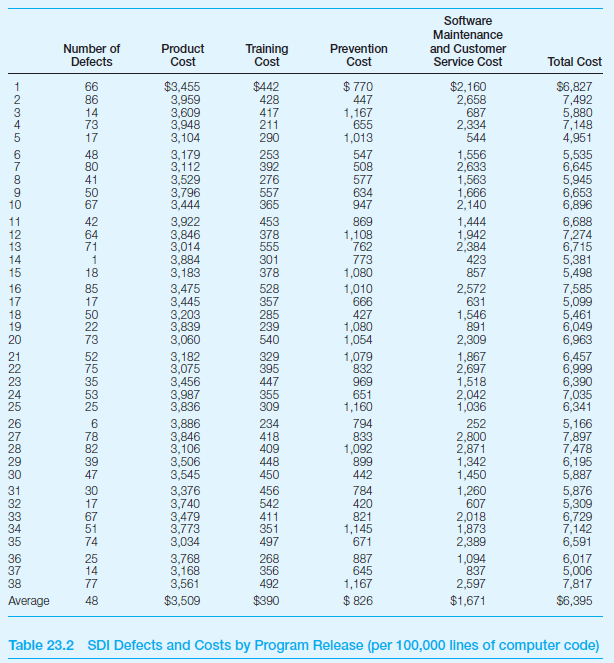
with other software in terms of data transfers and interfaces? Does it terminate abnormally? In spite of extensive testing of the software, programs always contain some "bugs" (defects). Once the software is released, SDI stands behind the product with phone in customer service consultants who answer questions and help the customer work around existing problems in the software. SDI also has a software maintenance group that fixes bugs and sends out revised versions of the programs to customers.
SDI has been tracking the relation between quality costs and quality. The quality measure it uses is the number of documented bugs in a software package. These bugs are counted when a customer calls in with a complaint and the SDI customer service representative determines that this is a new problem. The software maintenance programmers then set about fixing the program to eliminate the bug. To manage quality, SDI tracks quality costs. It has released 38 new or major revisions in existing packages during the last three years. Table 23.2 reports the number of defects documented in the first 6 months following release. Also listed in Table 23.2 is total product cost and quality cost per software package release.
Product cost includes all the costs incurred to produce and market the software, excluding the quality cost in Table 23.2. Quality cost consists of these components: training, prevention, and software maintenance and customer service costs. Training costs are those expenditures for educating the programmers and updating their training. Better-educated programmers produce fewer bugs. Prevention cost includes the expenditures for testing the software before it is released. Maintenance and customer service costs are those of the programmers charged with fixing the bugs and reissuing the revised software and the customer service representatives answering phone questions. The training and prevention costs are measured over the period the software is being developed, and the number of bugs and the maintenance and service costs are measured in the first six months following release.
All the numbers in Table 23.2 have been divided by lines of computer code in the particular program release. Programs with more lines of code cost more and also have more bugs. Prior studies find that using lines of code is an acceptable way to control for program complexity. Thus, the numbers in Table 23.2 are stated in terms of defects and cost per 100,000 lines of code.
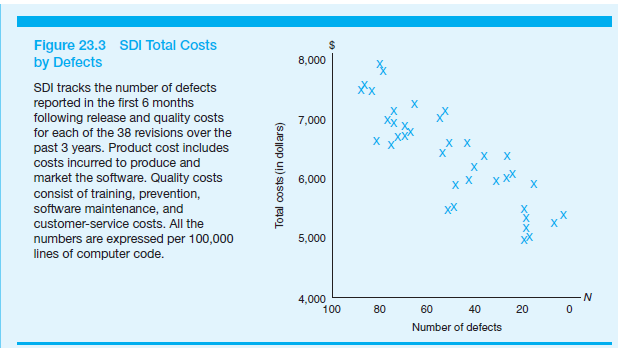
Figure 23.3 depicts the relation between total quality cost and number of defects. The vice president of quality of SDI likes to use Figure 23.3 to emphasize that costs and quality are inversely related.
She is fond of saying, "Quality pays! Our total costs are a declining function of the number of defects. The more we spend on quality, the lower our costs." Based on this analysis, the vice president has recommended a major investment in quality improvement, focusing specifically on prevention and training.
Evaluate the vice president's analysis:
1. What criteria should be used in deciding whether to invest more in quality?
2. Do you have sufficient data to evaluate such an investment proposal?
Software Maintenance Number of Product Cost Training Cost Prevention Cost and Customer Service Cost Defects Total Cost $ 770 447 $3,455 3,959 3,609 3,948 3,104 $442 428 417 211 290 $2,160 2,658 687 2,334 544 $6,827 7,492 5,880 7,148 4,951 66 86 14 73 17 3 4 1,167 655 1,013 1,556 2,633 1,563 1,666 2,140 1,444 1,942 2,384 423 857 3,179 3,112 3,529 3,796 3,444 48 80 41 50 67 253 392 276 557 365 547 508 577 634 947 5,535 6,645 5,945 6,653 6,896 8. 10 3,922 3,846 3,014 3,884 3,183 11 12 13 14 15 42 64 71 453 378 555 301 378 869 6,688 7,274 6,715 5,381 5,498 1,108 762 773 18 1,080 2,572 631 16 17 18 19 20 85 17 50 22 73 3,475 3,445 3,203 3,839 3,060 528 357 285 239 540 1,010 666 427 1,080 1,054 7,585 5,099 5,461 6,049 6,963 1,546 891 2,309 1,867 2,697 1,518 2,042 1,036 21 22 23 24 25 52 75 35 3,182 3,075 3,456 3,987 3,836 329 395 447 355 309 1,079 832 969 651 1,160 6,457 6,999 6,390 7,035 6,341 25 252 2,800 2,871 1,342 1,450 26 27 28 29 30 3,886 3,846 3,106 3,506 3,545 234 418 409 448 450 794 833 1,092 899 442 5,166 7,897 7,478 6,195 5,887 78 82 39 47 31 32 33 34 35 30 17 67 51 74 3,376 3,740 3,479 3,773 3,034 456 542 411 351 497 784 420 821 1,145 671 1,260 607 2,018 1,873 2,389 5,876 5,309 6,729 7,142 6,591 36 37 38 25 14 77 3,768 3,168 3,561 268 356 887 645 1,094 837 2,597 $1,671 6,017 5,006 7,817 1,167 492 $ 826 $3,509 $390 $6,395 Average 48 Table 23.2 SDI Defects and Costs by Program Release (per 100,000 lines of computer code) Figure 23.3 SDI Total Costs by Defects 8,000 SDI tracks the number of defects reported in the first 6 months following release and quality costs for each of the 38 revisions over the past 3 years. Product cost includes costs incurred to produce and market the software. Quality costs consist of training, prevention, software maintenance, and 7,000 6,000 * customer-service costs. All the 5,000 numbers are expressed per 100,000 lines of computer code. 4,000 100 80 60 40 20 Number of defects Total costs (in dollars)
Step by Step Solution
3.43 Rating (172 Votes )
There are 3 Steps involved in it
1 One often hears that quality is free In fact a wellknown quality expert has a bestselling book P Crosby Quality is Free New York McGrawHill 1979 This case allows the student to explore this issue by ... View full answer

Get step-by-step solutions from verified subject matter experts
 Study Help