







Question: Data Set 12 Passive and Active Smoke in Appendix B lists measures of cotinine from three groups of subjects: (1) smokers; (2) nonsmokers exposed to
Data Set 12 “Passive and Active Smoke” in Appendix B lists measures of cotinine from three groups of subjects: (1) smokers; (2) nonsmokers exposed to environmental tobacco smoke; (3) nonsmokers not exposed to environmental tobacco smoke. Cotinine is an indicator of nicotine absorption.
Use the methods from this chapter to explore and compare the cotinine measures in the three groups. Are there any notable differences? Are there any outliers? What do you conclude about the effects that smokers have on nonsmokers? Write a brief report of your conclusions, and provide supporting statistical evidence.
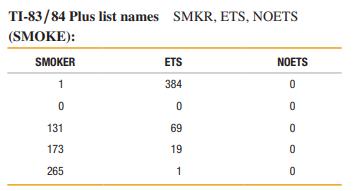
Data Set 12: Passive and Active Smoke
Data are from 120 subjects (first five rows shown here) in three groups: SMOKER includes subjects who are smokers, ETS includes nonsmokers exposed to environmental tobacco smoke, NOETS includes non-smokers not exposed to environmental tobacco smoke. All values are measured levels of serum cotinine (in ng>mL), a metabolite of nicotine. (When nicotine is absorbed by the body, cotinine is produced.) Data are from the U.S. Department of Health and Human Services, National Center for Health Statistics, Third National Health and Nutrition Examination Survey.
Step by Step Solution
3.50 Rating (167 Votes )
There are 3 Steps involved in it
To explore and compare the cotinine measures in the three groups smokers nonsmokers exposed to environmental tobacco smoke and nonsmokers not exposed ... View full answer

Get step-by-step solutions from verified subject matter experts
 Study Help