







Question: Define (phi: mathbb{R} ightarrow mathbb{R}) by (phi(x):=(1-cos x) mathbb{1}_{[0,2 pi)}(x)), let (u(x):=1, v(x):=phi^{prime}(x)) and (w(x):=int_{(-infty, x)} phi(t) d t). Then (i) (u star v(x)=0) for
Define \(\phi: \mathbb{R} ightarrow \mathbb{R}\) by \(\phi(x):=(1-\cos x) \mathbb{1}_{[0,2 \pi)}(x)\), let \(u(x):=1, v(x):=\phi^{\prime}(x)\) and \(w(x):=\int_{(-\infty, x)} \phi(t) d t\). Then
(i) \(u \star v(x)=0\) for all \(x \in \mathbb{R}\);
(ii) \(v \star w(x)=\phi \star \phi(x)>0\) for all \(x \in(0,4 \pi)\);
(iii) \((u \star v) \star w \equiv 0 eq u \star(v \star w)\).
Does this contradict the associativity of the convolution which is implicit in Theorem 15.6 ?
Data from problem 15.6

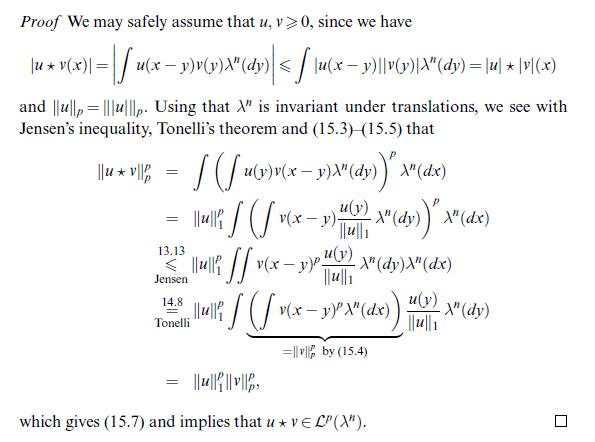
Theorem 15.6 (Young's inequality) Let ue L (X") and vELP(X"), p= [1,00). The convolution uv defines a function in LP (X") and satisfies u* v=v*u, and ||uv|p|u||1||v||p. (15.7)
Step by Step Solution
3.44 Rating (160 Votes )
There are 3 Steps involved in it
i ii iii No... View full answer

Get step-by-step solutions from verified subject matter experts
 Study Help