







Question: Consider the differences in differences (DID) estimator presented in Section 22.6. Suppose the time trend term (left(delta_{t}-delta_{t-1} ight)) differs across the treated and untreated groups.
Consider the differences in differences (DID) estimator presented in Section 22.6. Suppose the time trend term \(\left(\delta_{t}-\delta_{t-1}\right)\) differs across the treated and untreated groups.
(a) Will the DID estimator of \(\phi\) based on repeated cross-section data be consistent? Explain your answer.
(b) Is consistent estimation of \(\phi\) possible if panel data are available? Explain your answer.
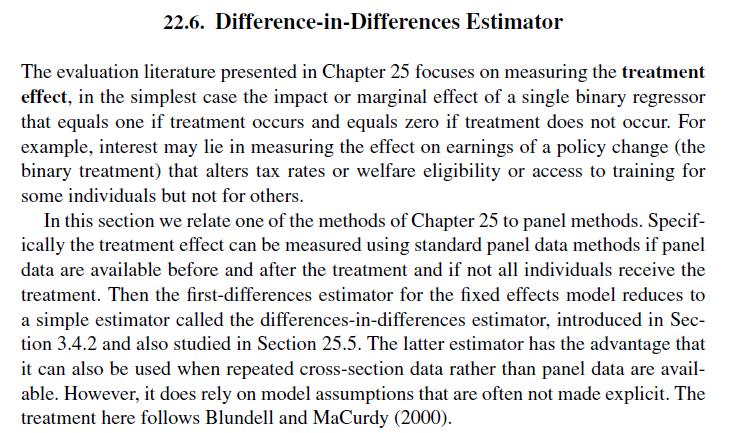
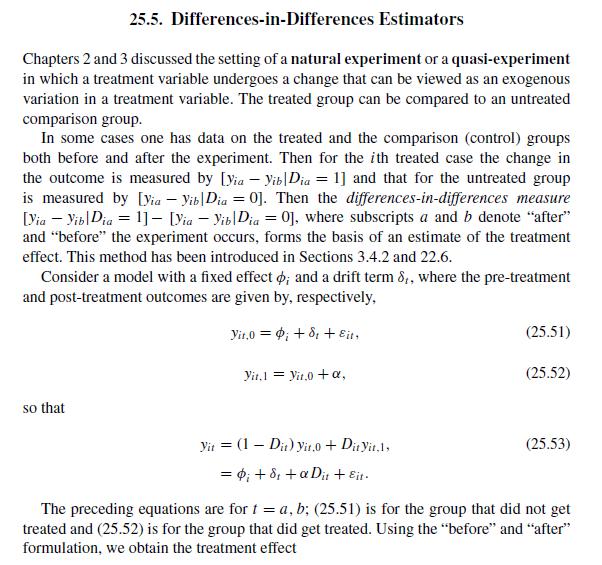
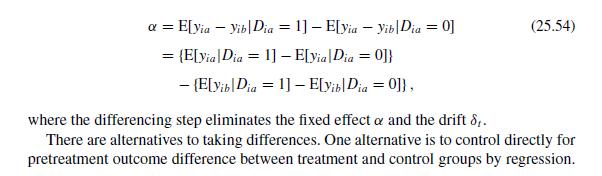
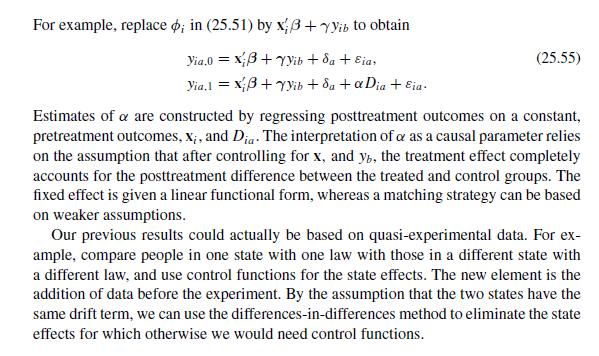
22.6. Difference-in-Differences Estimator The evaluation literature presented in Chapter 25 focuses on measuring the treatment effect, in the simplest case the impact or marginal effect of a single binary regressor that equals one if treatment occurs and equals zero if treatment does not occur. For example, interest may lie in measuring the effect on earnings of a policy change (the binary treatment) that alters tax rates or welfare eligibility or access to training for some individuals but not for others. In this section we relate one of the methods of Chapter 25 to panel methods. Specif- ically the treatment effect can be measured using standard panel data methods if panel data are available before and after the treatment and if not all individuals receive the treatment. Then the first-differences estimator for the fixed effects model reduces to a simple estimator called the differences-in-differences estimator, introduced in Sec- tion 3.4.2 and also studied in Section 25.5. The latter estimator has the advantage that it can also be used when repeated cross-section data rather than panel data are avail- able. However, it does rely on model assumptions that are often not made explicit. The treatment here follows Blundell and MaCurdy (2000).
Step by Step Solution
There are 3 Steps involved in it

Get step-by-step solutions from verified subject matter experts
 Study Help