







Question: This problem involves an example that illustrates the Cox-Tsiatsis nonidentification of the competing risks result mentioned in Section 19.2. Consider the following dependent competing risks
This problem involves an example that illustrates the Cox-Tsiatsis nonidentification of the competing risks result mentioned in Section 19.2. Consider the following dependent competing risks model in which we observe \(T=\min \left(T_{1}, T_{2}\right)\) and \(\delta\), where \(\delta=1\) if \(T=T_{1}\), and \(\delta=2\) if \(T=T_{2}\). Here \(T_{1}\) and \(T_{2}\) are latent durations of risks 1 and 2 , respectively. Suppose that the bivariate joint survivor function is \(S\left(t_{1}, t_{2}\right)=\exp \left[-\left(\lambda_{1} t_{1}+\lambda_{2} t_{2}\right)^{\alpha}\right]\), \(00\). Construct an independent CRM that is equivalent to the specified dependent competing risks model.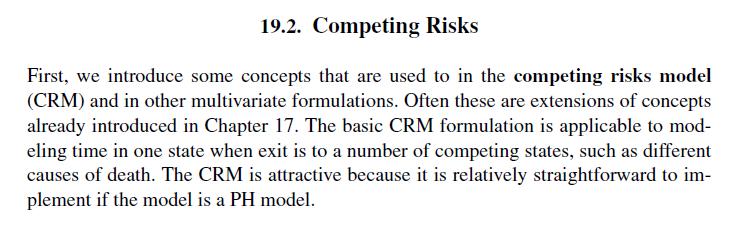
19.2. Competing Risks First, we introduce some concepts that are used to in the competing risks model (CRM) and in other multivariate formulations. Often these are extensions of concepts already introduced in Chapter 17. The basic CRM formulation is applicable to mod- eling time in one state when exit is to a number of competing states, such as different causes of death. The CRM is attractive because it is relatively straightforward to im- plement if the model is a PH model.
Step by Step Solution
3.47 Rating (154 Votes )
There are 3 Steps involved in it

Get step-by-step solutions from verified subject matter experts
 Study Help