







Question: Estimate the Debye length D , the Debye number N D , the plasma frequency fp p /2, and the electron deflection
Estimate the Debye length λD, the Debye number ND, the plasma frequency fp ≡ ωp/2π, and the electron deflection timescale tDee ∼ tDep, for the following plasmas.
(a) An atomic bomb explosion in Earth’s atmosphere 1ms after the explosion.
(b) The ionized gas that enveloped the Space Shuttle (Box 17.4) as it reentered Earth’s atmosphere.
(c) The expanding universe during its early evolution, just before it became cool enough for electrons and protons to combine to form neutral hydrogen (i.e., just before ionization “turned off ”).
Box 17.4
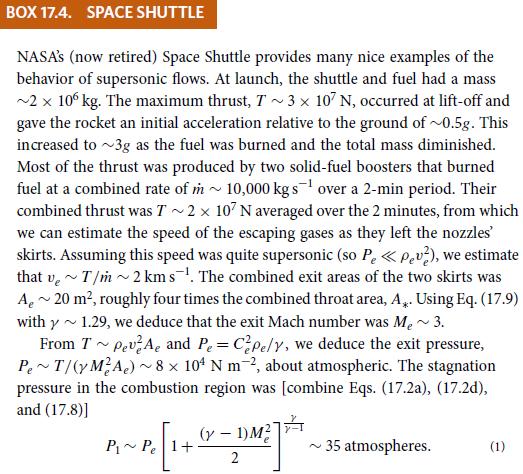
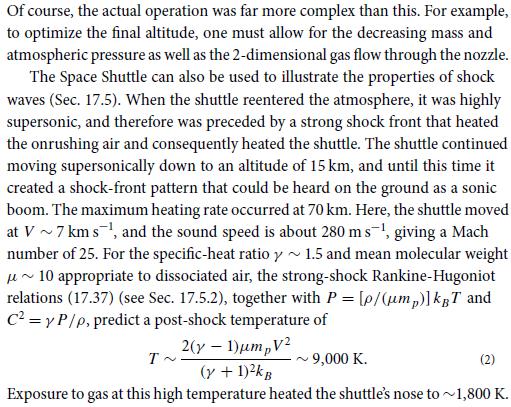
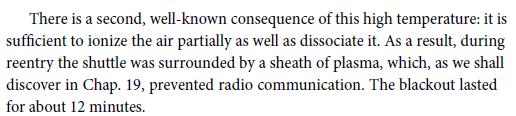
BOX 17.4. SPACE SHUTTLE NASA's (now retired) Space Shuttle provides many nice examples of the behavior of supersonic flows. At launch, the shuttle and fuel had a mass ~2 x 10⁶ kg. The maximum thrust, 7 ~ 3 107 N, occurred at lift-off and gave the rocket an initial acceleration relative to the ground of ~0.5g. This increased to ~3g as the fuel was burned and the total mass diminished. Most of the thrust was produced by two solid-fuel boosters that burned fuel at a combined rate of m~ 10,000 kg s- over a 2-min period. Their combined thrust was T~2 x 10⁷ N averaged over the 2 minutes, from which we can estimate the speed of the escaping gases as they left the nozzles' skirts. Assuming this speed was quite supersonic (so P < < Pev), we estimate that ve~T/m ~2 km s. The combined exit areas of the two skirts was A~20 m, roughly four times the combined throat area, A.. Using Eq. (17.9) with y~ 1.29, we deduce that the exit Mach number was Me~ 3. From T pA, and Pe= Cepe/y, we deduce the exit pressure, Pe~T/(MA)~8 104 N m2, about atmospheric. The stagnation pressure in the combustion region was [combine Eqs. (17.2a), (17.2d), and (17.8)] ~ B~B [1 + 0-DIME 2 35 atmospheres. (1)
Step by Step Solution
3.36 Rating (165 Votes )
There are 3 Steps involved in it

Get step-by-step solutions from verified subject matter experts
 Study Help