



Question: Suppose that a stress T zj applied (x o ) is applied on the face z = 0 of a half-infinite elastic body (one that
Suppose that a stress Tzjapplied (xo) is applied on the face z = 0 of a half-infinite elastic body (one that fills the region z >0). Then by virtue of the linearity of the elastostatics equation f = (K + 1/3μ)∇(∇ · ξ) + μ∇2ξ = 0 and the linearity of its boundary conditions, Tzjinternal = Tzjapplied, there must be a Green’s function Gjk(x − xo) such that the body’s internal displacement ξ(x) is given by

Here the integral is over all points xo on the face of the body (z = 0), and x can be anywhere inside the body, z ≥ 0.(a) Show that if a force Fj is applied on the body’s surface at a single point (the origin of coordinates), then the displacement inside the body is

Thus, the Green’s function can be thought of as the body’s response to a point force on its surface.
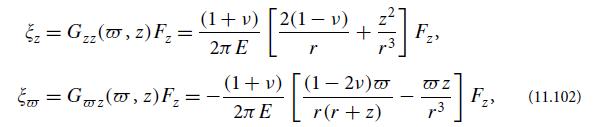
(b) As a special case, consider a point force Fz directed perpendicularly into the body. The resulting displacement turns out to have cylindrical components12
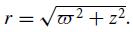
where
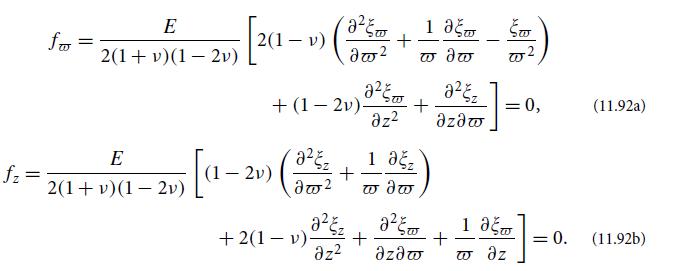
It is straight forward to show that this displacement does satisfy the elastostatics equations (11.92). Show that it also satisfies the required boundary condition

(c) Show that for this displacement [Eq. (11.102)],

vanishes everywhere on the body’s surface z = 0 except at the origin ω̅ = 0 and is infinite there. Show that the integral of this normal stress over the surface is Fz, and therefore, Tzz(z = 0) = Fzδ2(x), where δ2 is the 2-dimensional Dirac delta function on the surface. This is the second required boundary condition.
(d) Plot the integral curves of the displacement vector ξ (i.e., the curves to which ξ is parallel) for a reasonable choice of Poisson’s ratio ν. Explain physically why the curves have the form you find.
(e) One can use the Green’s function (11.102) to compute the displacement ξ induced by the Gaussian-shaped pressure (11.89) applied to the body’s face, and to then evaluate the induced expansion and thence the thermoelastic noise; see Braginsky, Gorodetsky, and Vyatchanin (1999) and Liu and Thorne (2000). The results agree with Eqs. (11.97) and (11.98) deduced using separation of variables.
Equations


j (X) = [G = (x)dxo. Gjk (X-Xo) 7applied (11.100)
Step by Step Solution
3.37 Rating (172 Votes )
There are 3 Steps involved in it

Get step-by-step solutions from verified subject matter experts