







Question: P9.10 Machine tools are often automatically controlled as shown in Figure P9.10. These automatic systems are often called numerical machine controls [9]. On each axis,
P9.10 Machine tools are often automatically controlled as shown in Figure P9.10. These automatic systems are often called numerical machine controls [9]. On each axis, the desired position of the machine tool is com
pared with the actual position and is used to actuate a solenoid coil and the shaft of a hydraulic actuator. The transfer function of the actuator is 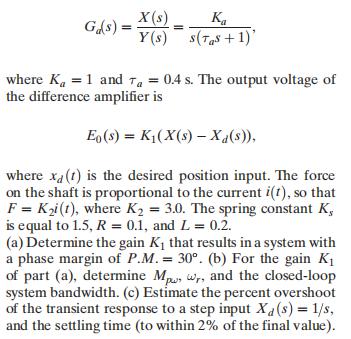
X(s) Ka Gas)= = Y(s) s(Tas+1) where K = 1 and T = 0.4 s. The output voltage of the difference amplifier is Eo(s) = K(X(s)-Xa(s)), where x(t) is the desired position input. The force on the shaft is proportional to the current i(t), so that F = K2i(t), where K = 3.0. The spring constant K is equal to 1.5, R = 0.1, and L = 0.2. (a) Determine the gain K that results in a system with a phase margin of P.M. = 30. (b) For the gain K of part (a), determine Mp, wr, and the closed-loop system bandwidth. (c) Estimate the percent overshoot of the transient response to a step input Xa(s) = 1/s, and the settling time (to within 2% of the final value).
Step by Step Solution
There are 3 Steps involved in it

Get step-by-step solutions from verified subject matter experts
 Study Help