







Question: A surprisingly realistic microscopic model for the charge density of a semi-infinite metal (with z = 0 as its macroscopic surface) consists of a positive
A surprisingly realistic microscopic model for the charge density of a semi-infinite metal (with z = 0 as its macroscopic surface) consists of a positive charge distribution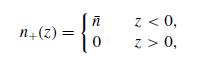
And a negative charge distribution: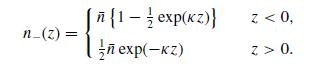
(a) Sketch n+(z) and n−(z) on the same graph and give a physical explanation of why they might be reasonable.
(b) Calculate the dipole moment p per unit area of surface for this system.
(c) Calculate the electrostatic potential φ(z) and sketch it in the interval −∞ (d) Calculate and explain the value of φ(∞) − φ(−∞).
(d) Calculate the total electrostatic energy per unit area of this system.
n+(z) = { 0 Z < 0, Z > 0,
Step by Step Solution
3.45 Rating (174 Votes )
There are 3 Steps involved in it
a The form of nz smears out the charge due to the positive nuclei but recognizes that there ... View full answer

Get step-by-step solutions from verified subject matter experts
 Study Help