







Question: Let () / 0 = 1 2 p / 2 be the dielectric function of a plasma where p is the plasma
Let ϵ(ω) / ϵ0 = 1 − ω2p /ω2 be the dielectric function of a plasma where ωp is the plasma frequency. In a typical laboratory or astrophysical environment, any attempt to create a voltage drop V (t) = V cos ωt across the plasma generates a region of vacuum (called the “sheath”) on either side of the plasma volume as indicated in the one-dimensional sketch below.
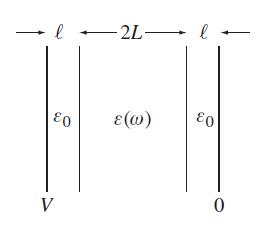
(a) Derive expressions for the uniform electric field EP (t) = EP cos ωt in the plasma and for the uniform electric field ES (t) = ES cos ωt in the sheath. Assume there is no free charge anywhere. Assume also that ωp is small enough that an electrostatic approximation is always valid.
(b) Plot the field amplitudes EP and ES on the same graph as a function of frequency. Discuss where the voltage drop occurs and why when (1) ω p, (2) ω = ωp, and (3) ω >> ωp.
(c) Make an “LC circuit” interpretation of the resonance behavior at ω = ωp / √ 1 + L/ℓ.
-2L- 80 (w) V l 80 0
Step by Step Solution
3.39 Rating (149 Votes )
There are 3 Steps involved in it
a Derivation of EPt and ESt In the region of the plasma the dielectric function is given as 0 1 p22 where p is the plasma frequency For a voltage drop ... View full answer

Get step-by-step solutions from verified subject matter experts
 Study Help