







Question: Let (t ) = Re E(0, t) = a 1 cos(t 1 )e 1 + a 2 cos(t 2 )e
Let ε(t ) = Re E(0, t) = a1cos(ωt − δ1)ê1 + a2 cos(ωt − δ2)ê2. Except for the case of linear polarization, this vector sweeps out an ellipse as a function of time. Show that the rate at which E sweeps out area within the ellipse is
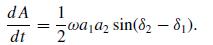
This shows that E(t) sweeps out equal areas in equal time. This is similar to Kepler’s second law except that the origin of E(t) is the center of the polarization ellipse while the origin of the radius vector in Kepler’s law is the focus of an orbital ellipse.
dA dt || 1 2 waja sin(8-8).
Step by Step Solution
3.37 Rating (150 Votes )
There are 3 Steps involved in it
Let be the angle between Et and the axis Then a2 coswt 8 a coswt 8 Taking the time derivativ... View full answer

Get step-by-step solutions from verified subject matter experts
 Study Help