



Question: N identical point particles, each with charge q, move in a circle of radius a. The angular position of the j th particle is
N identical point particles, each with charge q, move in a circle of radius a. The angular position of the jth particle is φj(t) = ω0(t − t0) + θj.
(a) Prove that the power spectrum satisfies N identical point particles, each with charge q, move in a circle of radius a. The angular position of the jth particle is φj (t) = ω0(t − t0) + θj .
(a) Prove that the power spectrum satisfies
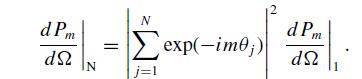
(b) Specialize to the case where the charges are equally spaced around the circle at all times. Use part (a) to prove that this configuration radiates only at the frequencies kNω0 where k is a positive integer.
(c) Show that dPm/d when the charges are distributed randomly around the ring.
dPm IN N exp(-imt;) j=1 dPm d 1
Step by Step Solution
3.40 Rating (169 Votes )
There are 3 Steps involved in it

Get step-by-step solutions from verified subject matter experts