







Question: There has been a shift recently away from using harsh chemicals to dye textiles in favor of natural plant extracts. The article Ecofriendly Dyeing of
There has been a shift recently away from using harsh chemicals to dye textiles in favor of natural plant extracts. The article “Ecofriendly Dyeing of Silk with Extract of Yerba Mate” (Textile Res. J. 2017: 829– 837) describes an experiment to study the effects of dye concentration (mg/L), temperature (°C), and pH on dye adsorption (mg of dye per gram of fabric). [The article also included pictures of the resulting color from each treatment combination; dye adsorption is a proxy for color here.]
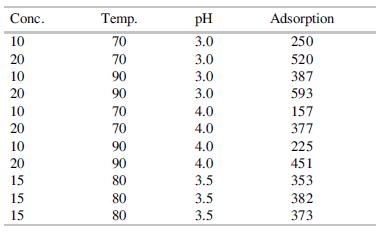
a. Obtain the estimated regression equation for this data. Then, interpret the coefficient on temperature.
b. Calculate a point estimate for mean dye adsorption when concentration = 15 mg/L, temperature = 80°C, and pH = 3.5 (i.e., the settings of the last three experimental runs).
c. The model utility test results in a test statistic value of ƒ= 44.02. What can be concluded at the α = .01 level?
d. Calculate and interpret a 95% CI for the settings specified in part (b).
e. Calculate and interpret a 95% PI for the settings specified in part (b).
f. Perform variable utility tests on each of the predictors. Can each one be judged useful provided that the other two are included in the model?
Conc. 10 20 10 20 10 20 10 20 15 15 15 Temp. 70 70 90 90 70 70 90 90 80 80 80 pH 3.0 3.0 3.0 3.0 4.0 4.0 4.0 4.0 3.5 3.5 3.5 Adsorption 250 520 387 593 157 377 225 451 353 382 373
Step by Step Solution
3.52 Rating (159 Votes )
There are 3 Steps involved in it

Get step-by-step solutions from verified subject matter experts
 Study Help