







Question: Verify that the mapping (e ightarrow 1) and (a ightarrow-1) gives a representation of the cyclic group (mathrm{C}_{2}) described in Box 2.2 that
Verify that the mapping \(e \rightarrow 1\) and \(a \rightarrow-1\) gives a representation of the cyclic group \(\mathrm{C}_{2}\) described in Box 2.2 that preserves the group multiplication, as does the trivial mapping \(e \rightarrow 1\) and \(a \rightarrow 1\). Show that these two representations are irreducible and that they are in fact the only irreps for \(\mathrm{C}_{2}\), up to possible isomorphisms.
Data from Box 2.2
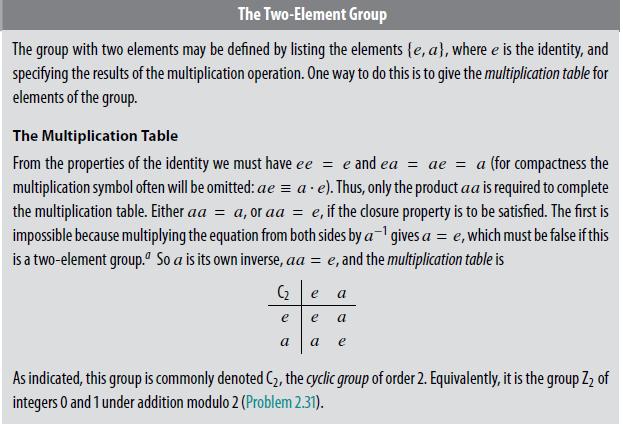
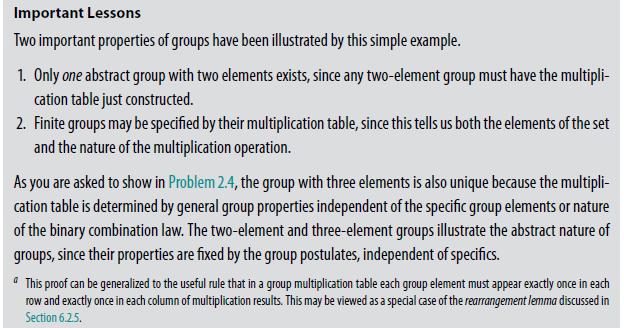
The Two-Element Group The group with two elements may be defined by listing the elements {e, a), where e is the identity, and specifying the results of the multiplication operation. One way to do this is to give the multiplication table for elements of the group. The Multiplication Table From the properties of the identity we must have ee = e and ea = ae = a (for compactness the multiplication symbol often will be omitted: ae = a e). Thus, only the product aa is required to complete the multiplication table. Either aa = a, or aa = e, if the closure property is to be satisfied. The first is impossible because multiplying the equation from both sides by a gives a = e, which must be false if this is a two-element group. So a is its own inverse, aa =e, and the multiplication table is e a e e a a a e As indicated, this group is commonly denoted C, the cyclic group of order 2. Equivalently, it is the group Z of integers 0 and 1 under addition modulo 2 (Problem 2.31).
Step by Step Solution
3.48 Rating (148 Votes )
There are 3 Steps involved in it

Get step-by-step solutions from verified subject matter experts
 Study Help