







Question: The unemployment rate also fails to capture all of the people who have given up looking for work, reports the New York Times. This is
“The unemployment rate also fails to capture all of the people who have given up looking for work,” reports the New York Times. This is one of many complaints about how the U.S. government measures the unemployment rate.
But as hinted at in the chapter, the U.S. government actually does count these
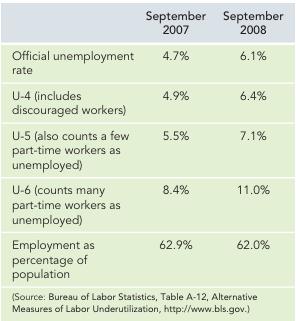
“discouraged workers,” and it includes them in the ‘U-4’, ‘U-5’, and ‘U-6’ definitions of unemployment. The government also has a few other measures of the labor market: It just so happens that the media typically ignore these measures. Let’s look at these measures in 2007 and 2008 as the U.S. economy slowed and the official “unemployment rate” rose to see if we get a different story. L 0 1
Answer the following questions:
a. For each of the five measures, calculate the rise in the unemployment rate (or, in one case, the fall in the employment rate).
b. Do any of these alternate measures indicate that the rise in the unemployment rate was larger than the official measure would indicate? Which ones?
c. Do any of these alternate measures indicate that the rise in the unemployment rate was twice as big as the official measure? (That might serve as a rough measure of whether our official measure is off by a lot.) Which ones?
d. Which of these alternate measures indicate at first glance that the labor market is actually a little better than the official measure? What is it about the denominator of this value that makes this change smaller than the rest?
September September 2007 2008 Official unemployment 4.7% 6.1% rate U-4 (includes 4.9% 6.4% discouraged workers) U-5 (also counts a few 5.5% 7.1% part-time workers as unemployed) U-6 (counts many 8.4% 11.0% part-time workers as unemployed) Employment as 62.9% 62.0% percentage of population (Source: Bureau of Labor Statistics, Table A-12, Alternative Measures of Labor Underutilization, http://www.bls.gov.)
Step by Step Solution
There are 3 Steps involved in it

Get step-by-step solutions from verified subject matter experts
 Study Help