Question: Replace the cosine grating in the previous problem with a square bar grating, that is, a series of many fine alternating opaque and transparent bands

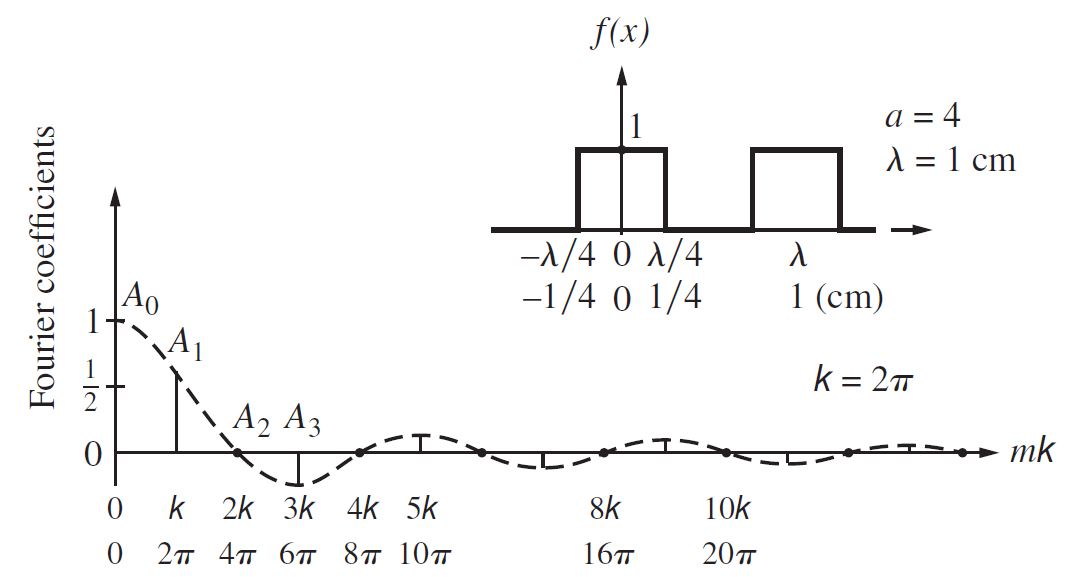
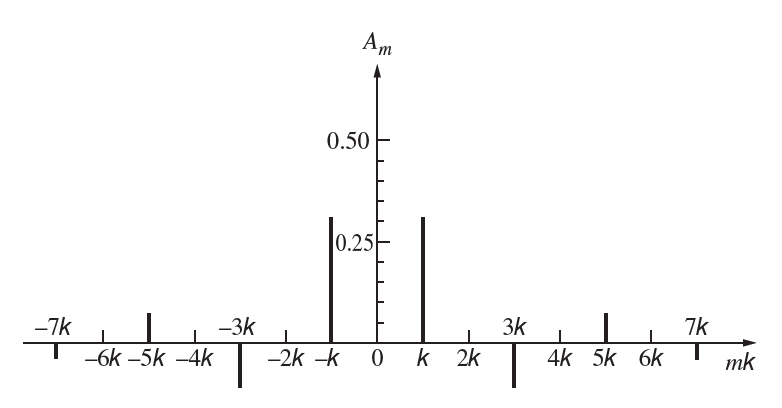
Replace the cosine grating in the previous problem with a €œsquare€ bar grating, that is, a series of many fine alternating opaque and transparent bands of equal width. We now filter out all terms in the transform plane but the zeroth and the two first-order diffraction spots. These we determine to have relative irradiances of 1.00, 0.36, and 0.36: compare them with Figs. 7.40a and 7.42. Derive an expression for the general shape of the irradiance distribution on the image plane€”make a sketch of it. What will the resulting fringe system look like?

Figs. 7.40a

f(x) a = 4 Л3 1 сm -1/4 0 A/4 -1/4 0 1/4 λ 1 (cm) |Ao 14, k%3D 2т || Аз Аз mk 0 к 2k 3k 4k 5k 8k 10k 0 2т 4т

Figs. 7.42

Am 0.50 0.25 -7k -3k 3k 7k T -6k –5k -4k -2k -k k 2k 4k 5k 6k т mk

f(x) a = 4 3 1 m -1/4 0 A/4 -1/4 0 1/4 1 (cm) |Ao 14, k%3D 2 || mk 0 2k 3k 4k 5k 8k 10k 0 2 4 8 10 16 20 Fourier coefficients Am 0.50 0.25 -7k -3k 3k 7k T -6k 5k -4k -2k -k k 2k 4k 5k 6k mk

Step by Step Solution

3.38 Rating (179 Votes )

There are 3 Steps involved in it

1 Expert Approved Answer
Step: 1 Unlock

The relative field amplitudes are 100 060 and 060 hence This is a cosine oscillati... View full answer

blur-text-image
Question Has Been Solved by an Expert!

Get step-by-step solutions from verified subject matter experts

Step: 2 Unlock
Step: 3 Unlock

Students Have Also Explored These Related Optics Questions!