







Question: (a) Is the maximum displacement the same for all particles of the string in Figure 16.12? For all particles of the string in Figure 16.13?
(a) Is the maximum displacement the same for all particles of the string in Figure 16.12? For all particles of the string in Figure 16.13?
(b) For each string, sketch a displacement curve for a point near the left end of the string.
(c) Repeat part \(b\) for the point of each string at which the pulses meet.
(d) Reconcile your answer to part \(a\) with your sketches for parts \(b\) and \(c\).
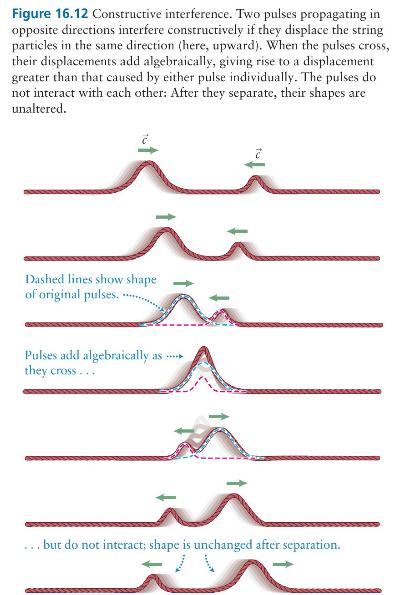
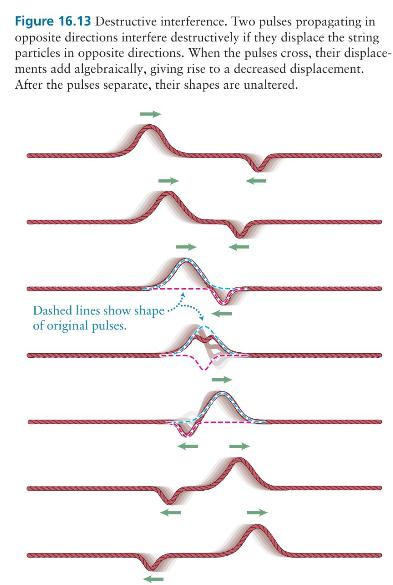
Figure 16.12 Constructive interference. Two pulses propagating in opposite directions interfere constructively if they displace the string particles in the same direction (here, upward). When the pulses cross, their displacements add algebraically, giving rise to a displacement greater than that caused by either pulse individually. The pulses do not interact with each other: After they separate, their shapes are unaltered. Dashed lines show shape of original pulses. Pulses add algebraically as .... they cross... i but do not interact; shape is unchanged after separation.
Step by Step Solution
3.42 Rating (171 Votes )
There are 3 Steps involved in it
a No To see why assume for simplicity that the pulses overlap at the midpoint of each string In Figu... View full answer

Get step-by-step solutions from verified subject matter experts
 Study Help