







Question: In Example 14.3 what is the time interval (Delta t) it takes the ball to pass through the moving tube if (v_{mathrm{b}}=v_{mathrm{t}}=v) ? Express your
In Example 14.3 what is the time interval \(\Delta t\) it takes the ball to pass through the moving tube if \(v_{\mathrm{b}}=v_{\mathrm{t}}=v\) ? Express your answer in terms of \(\ell\) and \(v\).
Data from Example 14.3
Consider a spring-loaded device that ejects a ball at some unknown everyday speed \(v_{\mathrm{b}}\). To measure this speed, you measure the time interval it takes the ball to pass through a stationary tube of known length \(\ell\) (Figure 14.8). Now suppose the tube is moving at speed \(v_{\mathrm{t}}\) toward the ejection device. What speed do you obtain by dividing the length \(\ell\) of the tube by the time interval \(\Delta t\) it takes the ball to pass through the tube? Express your answer in terms of \(v_{\mathrm{b}}\) and \(v_{\mathrm{t}}\).
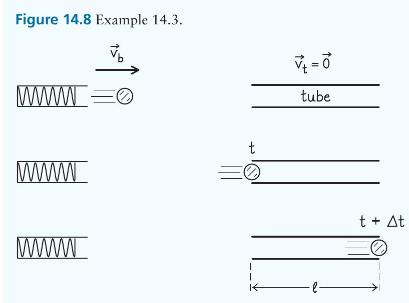
Figure 14.8 Example 14.3. vb wwwww=0 wwwww wwwww t K tube t + At
Step by Step Solution
There are 3 Steps involved in it

Get step-by-step solutions from verified subject matter experts
 Study Help